
Blog, 2026
Scroll down for the latest
or click the McAllister Art Collective logo above to return to the home page
1/18/2026: Well, it’s been quite the busy time since I made my last blog entry in the ‘through 2025’ page. Despite being fully vaccinated, before Christmas I got the really bad flu that’s been going around, which pretty much took me out for three whole weeks, followed by a bacterial secondary…. as that tapered off, a family member in a different city had a medical emergency, one which continues. As a result, I haven’t done much over the holiday season to now. One thing I did do, however, was take photos of some pieces done my my father and mother years ago, which I’ll get posted over the next couple of days. I grew up surrounded by art, which has no doubt had an influence on my artistic directions…
3/31/2026: Well here it is two months and change later, and I still didn’t get around to updating my blog… but now it’s time. The entries below are dated according to when they happened, as best I recall… Been an exceedingly busy few months, and not in a good way. But while all the undesired excitement was happening, I still managed to go to a few art events and create a few things, and now that things are starting to settle down it’s time to share them on this page! First up: On February 7th, we (my wife, the “Fat Happy Dragon Co. CEO”) and I (“Staff Artist” for the same) had a couple of booths at the Helena, MT Civic Center’s Feb Fest (Valentine’s Day) show. We sold an amazing number of 5×7 cards and absolutely zero paintings… At our last Civic Center show, we made far more from paintings than from cards. There’s no outguessing what will be in demand on any given day! Here’s a pic of our two tables (below):
I really have to hand it to a couple of the staff at the Civic Center! Byron Dike and Natasha Hoover bend over backwards to make sure that vendors have everything they need. For each of these events they work a ridiculous number of hours making sure that when folks come in the door they find a first-rate experience. BTW, the Civic Center website is at https://www.helenamt.gov/Community/Civic-Center ; I really encourage anyone in or visiting Helena to check it out. Lots of great events, first-class performances by the Helena Symphony and other local and national acts / entertainment in the auditorium, and a fascinating history. Check it out!
My wife and I celebrate our anniversary, her birthday, and Valentine’s Day all within a short period of February. For this year, I made some heart-shaped mini–Black Forest Cherry Tortes - chocolate cake, a cherry kirsch middle layer, and an airy-light vanilla frosting, topped with grated dark chocolate and a dark maraschino cherry. I worked as a pastry cook for a short time many, many, many years ago, and I really enjoyed the creative aspects of the job. Here’s a pic of one (below):
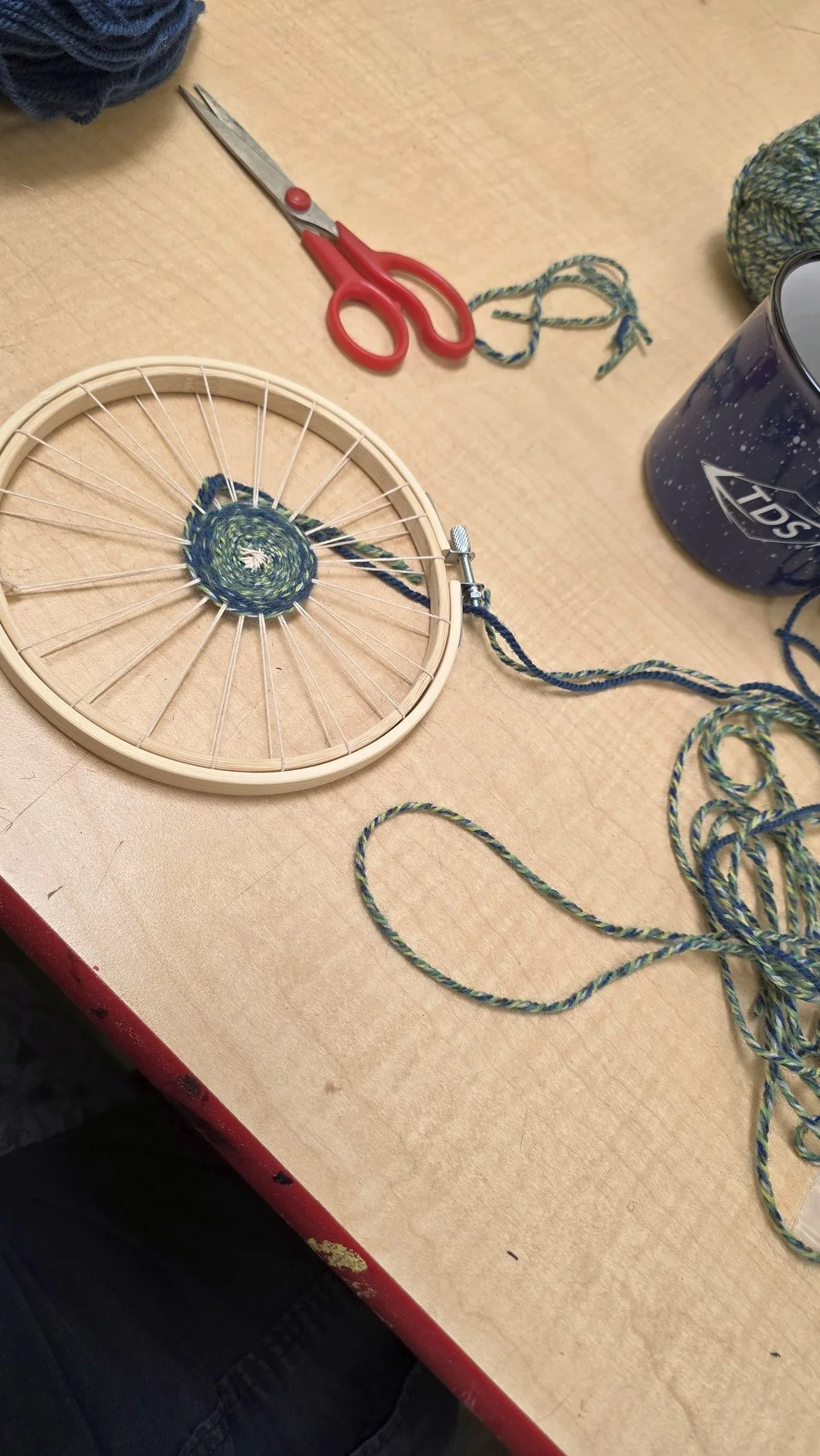
02/24/2026: The Holter Museum of Arts (Helena, MT) is in the middle of a series of arts sessions for veterans of military service, which they’ve named “Courage to Create”. Any veteran or veteran’s caregiver is welcome to attend, Tuesdays from 10 to noon and/or Thursdays from 5-7pm. There’s absolutely no cost as it’s all covered by a couple of grants (I’ve posted about it before; see my blog page up through 2025). It’s a great group of veterans, folks who can speak each other’s language and understand our military experiences. Every two or three weeks, we are introduced to a different art form. I’ll be instructing - or perhaps I should say facilitating - a couple of sessions on painting with acrylics this June. In February, we did some circular weaving - sort of like Native American ‘Dream Catchers’, but as a solid textile instead of a web. Interesting, but I’ve decided that this is not one of the art forms I intend to pursue. Nevertheless, here’s the first few rounds of mine (below):
3/10/2026: Omerta Arts, located here in Helena, recently received a new grant to serve veterans through the ceramic arts - something they’ve done before, and which got me back into “playing with mud”. For the opening session of this round, I thought I’d try something a bit different from the ceramic sculpture dragons and waves I’ve done before, and so I did this reclining female nude (below). It’s drying for the kiln, and so far there’s not a single fracture! I wanted to keep it from being too detailed; my thought was that I’d shoot for a finish texture more akin to Alberto Giacometti’s later work than the polish of a renaissance artist, but without the extreme elongation of Giacometti’s post-WWII sculptures. In the end, “she” wound up a bit smoother than intended, but that’s OK. Once it’s dry, I’m thinking I’ll glaze the entire figure in a shiny metallic black… we’ll see.
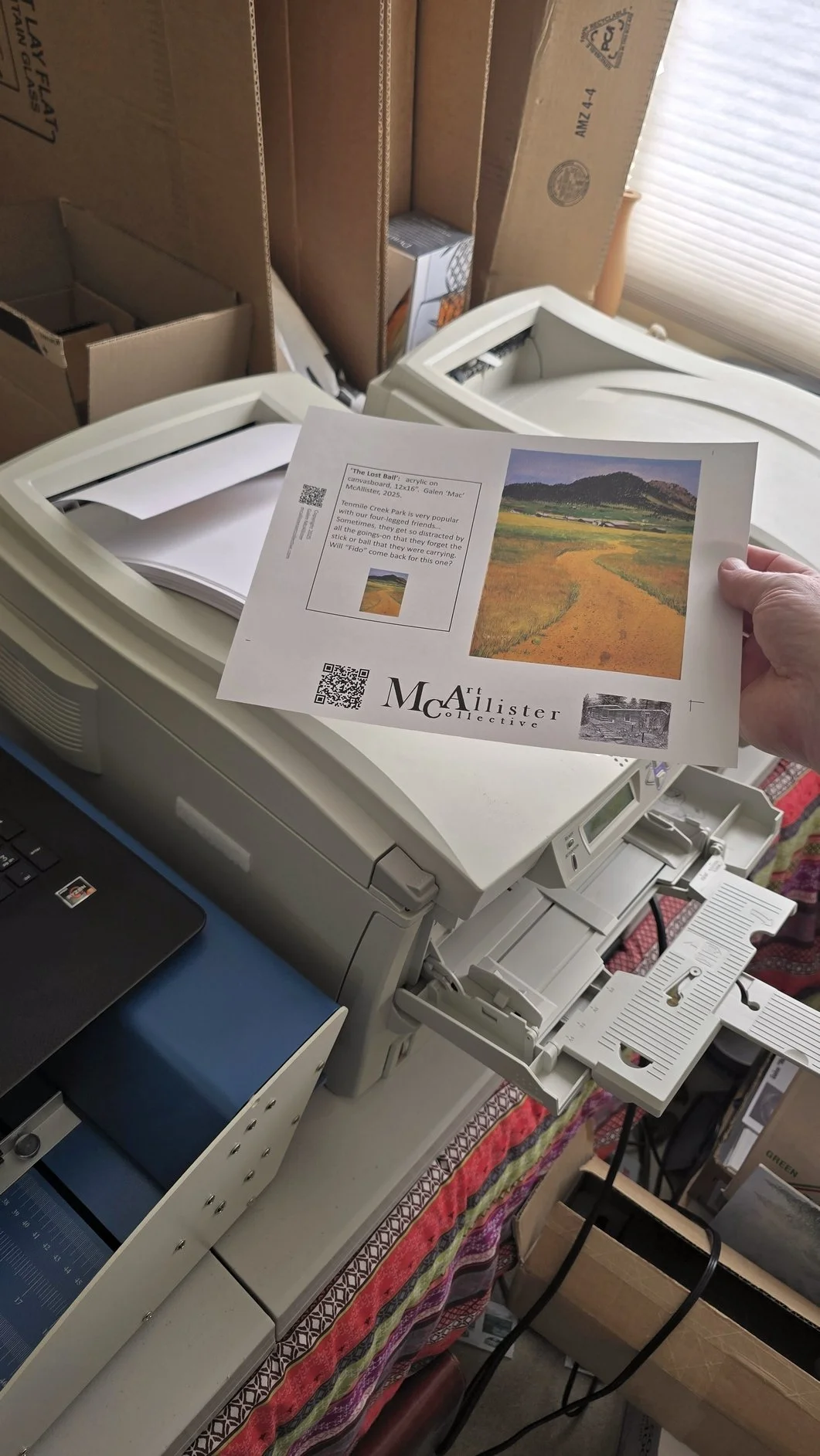
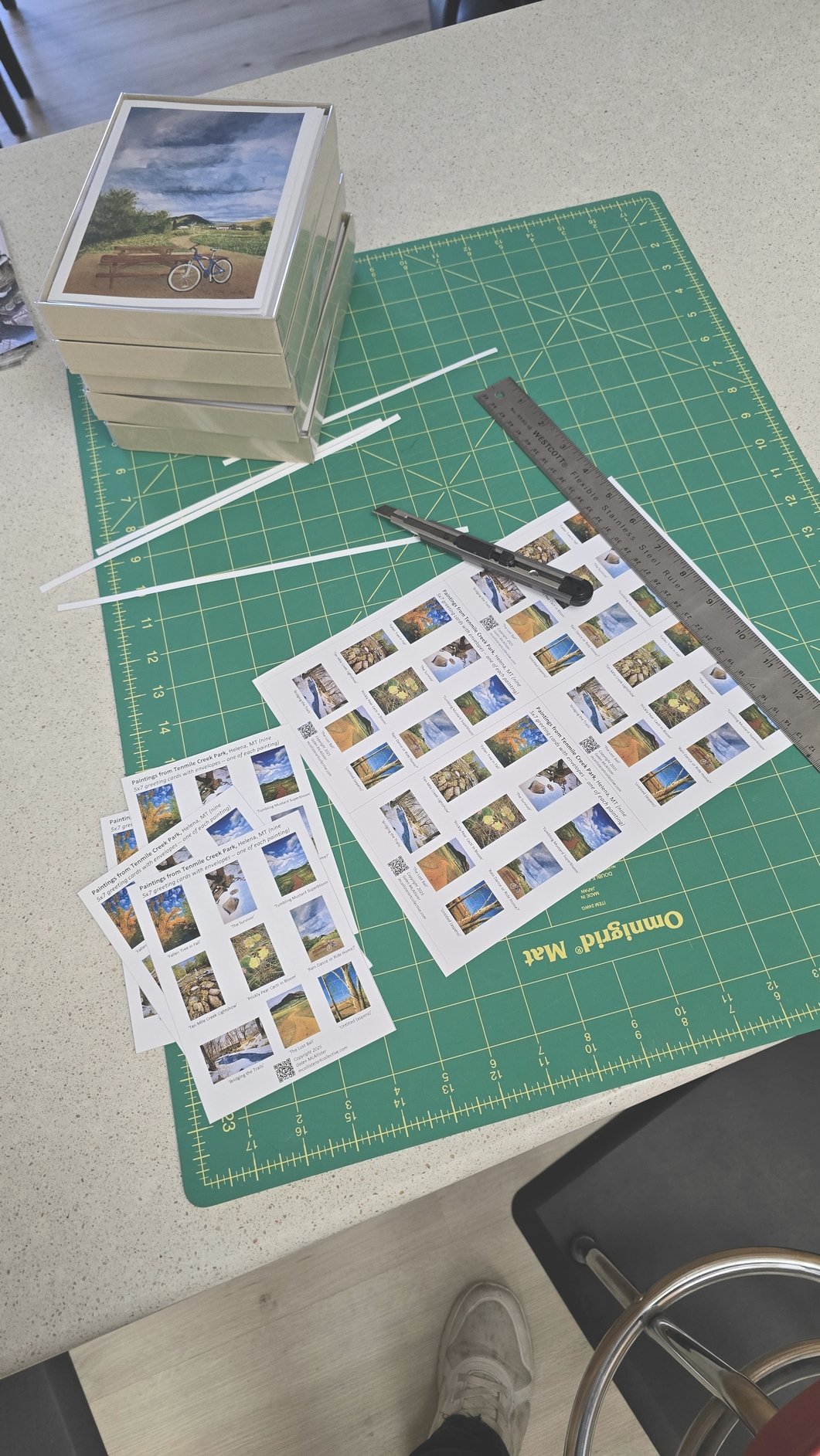
03/21/2026: I spent this day making 5×7 greeting cards from the paintings of Tenmile Creek Park that I did last year - in part as a fundraiser for the Prickly Pear Land Trust and the Helena College arts program; at this point, two originals have been sold, yeilding a small donation to each. I thought I’d show how I’m making these cards. So far, it’s a small-volume operation; if I ever get to where I’m selling thousands instead of dozens, I’ll have to have them made commercially. The profit margin on these is ridiculously small, but I figure it’s worth it so that a) more people can enjoy my paintings and b) it helps get my name out there… These will be available at Omerta Arts as single cards or boxes of all nine paintings. I print them on my very old laser printers, an Oki 5100 and Oki 5400 (ca. 2004), which still work just fine. Although not truly archival, I’ve printed signs on these that were posted outside for an entire year without any visible fading of the image or yellowing of the paper, so I’m reasonably confident that they’ll hold up long enough! When I trim them from the 8&1/2 × 11 inch sheet,, the part you see at the bottom becomes a bookmark which I give away for free. I used to throw the trimmed paper away, before one day the ‘light bulb went on’ and I realized that there could be a practical use for that piece.
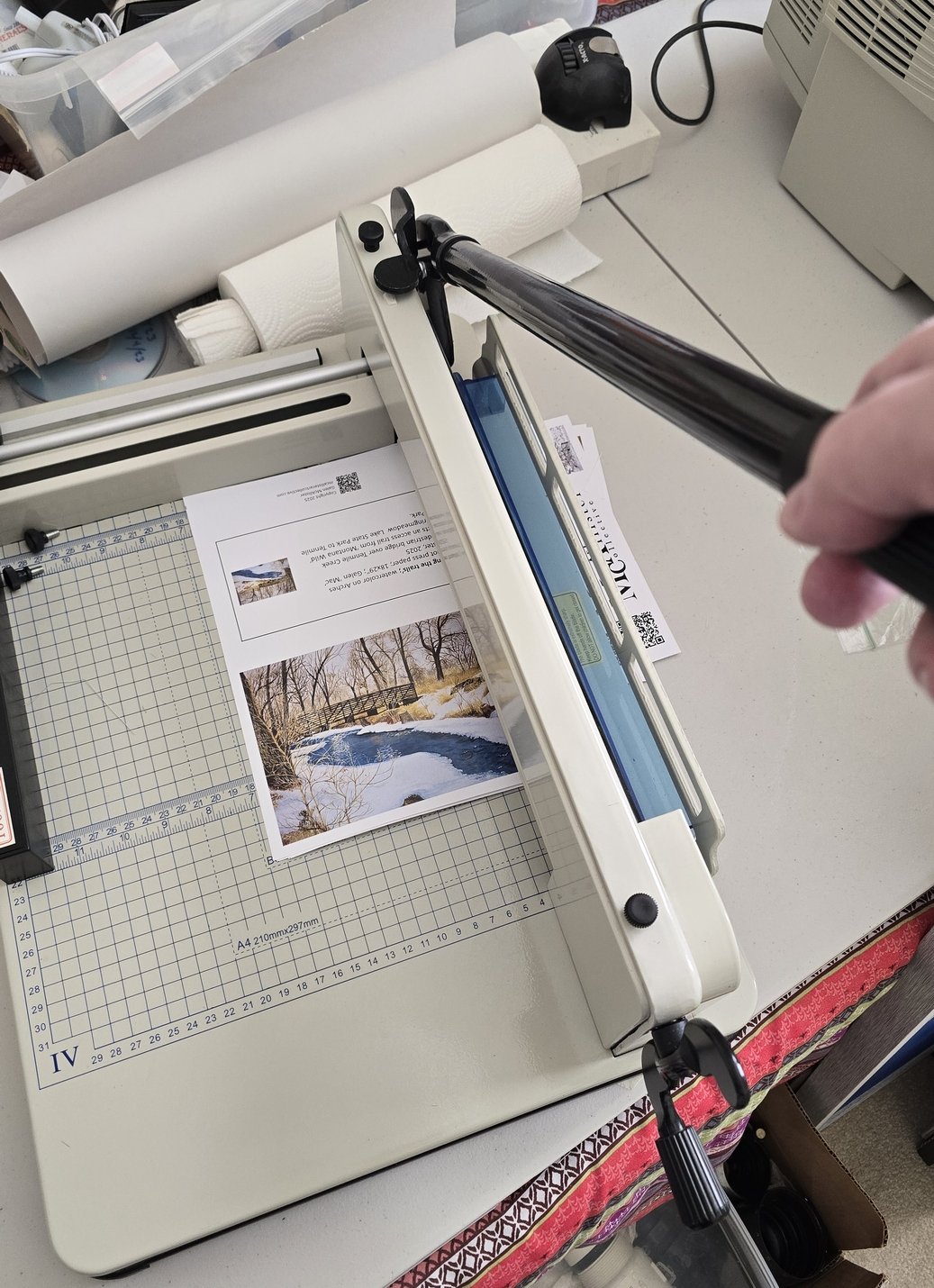
I have a fairly heavy-duty paper cutter to trim these… up to about 50 at a time. Here, I’m just trimming a few to get the photo…
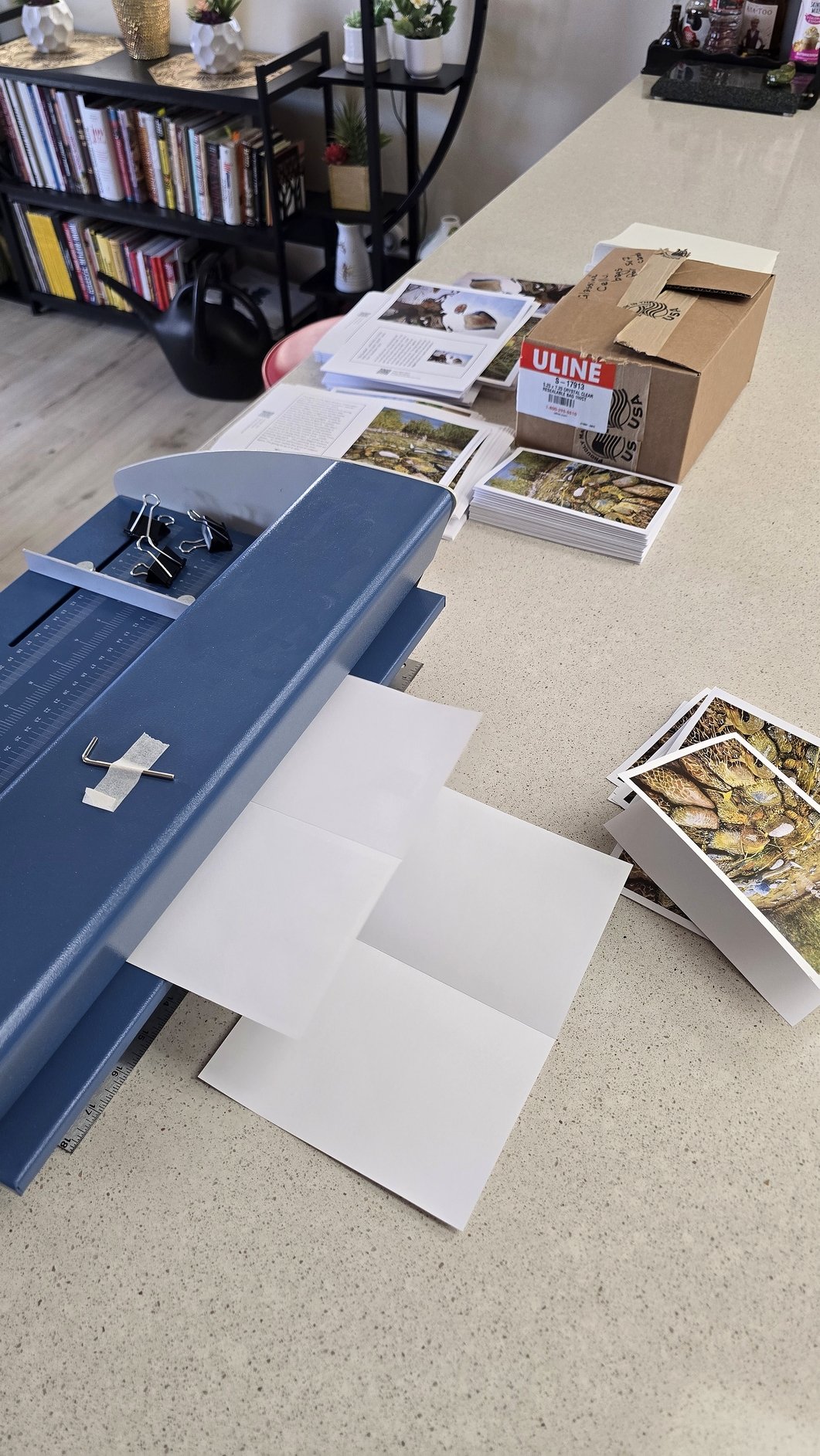
The next step is to run them through a ‘creaser’, which makes an indentation for folding them far more precisely and cleanly than trying to fold them strictly by hand. If I was a huge corporation, of course, I’d have the fancy machines that print, trim, fold and package cards all in one continuous operation… but those machines cost somewhere around the same as our house! So once it’s through the creaser, we still finish folding by hand.
We (my wife and I ) place individual cards, along with a mailing envelope, in clear ‘glassine’ envelopes. Card collections along with mailing envelopes go in clear-top ‘view boxes’. For the boxes, we print a ‘box-backer’ that shows what’s in the box. Here, we’re cutting the ‘box-backers’ prior to glueing them onto the back of the ‘view boxes’. It’s all a bit labor-intensive, but we simply don’t sell at the volumes which would justify fancy equipment.
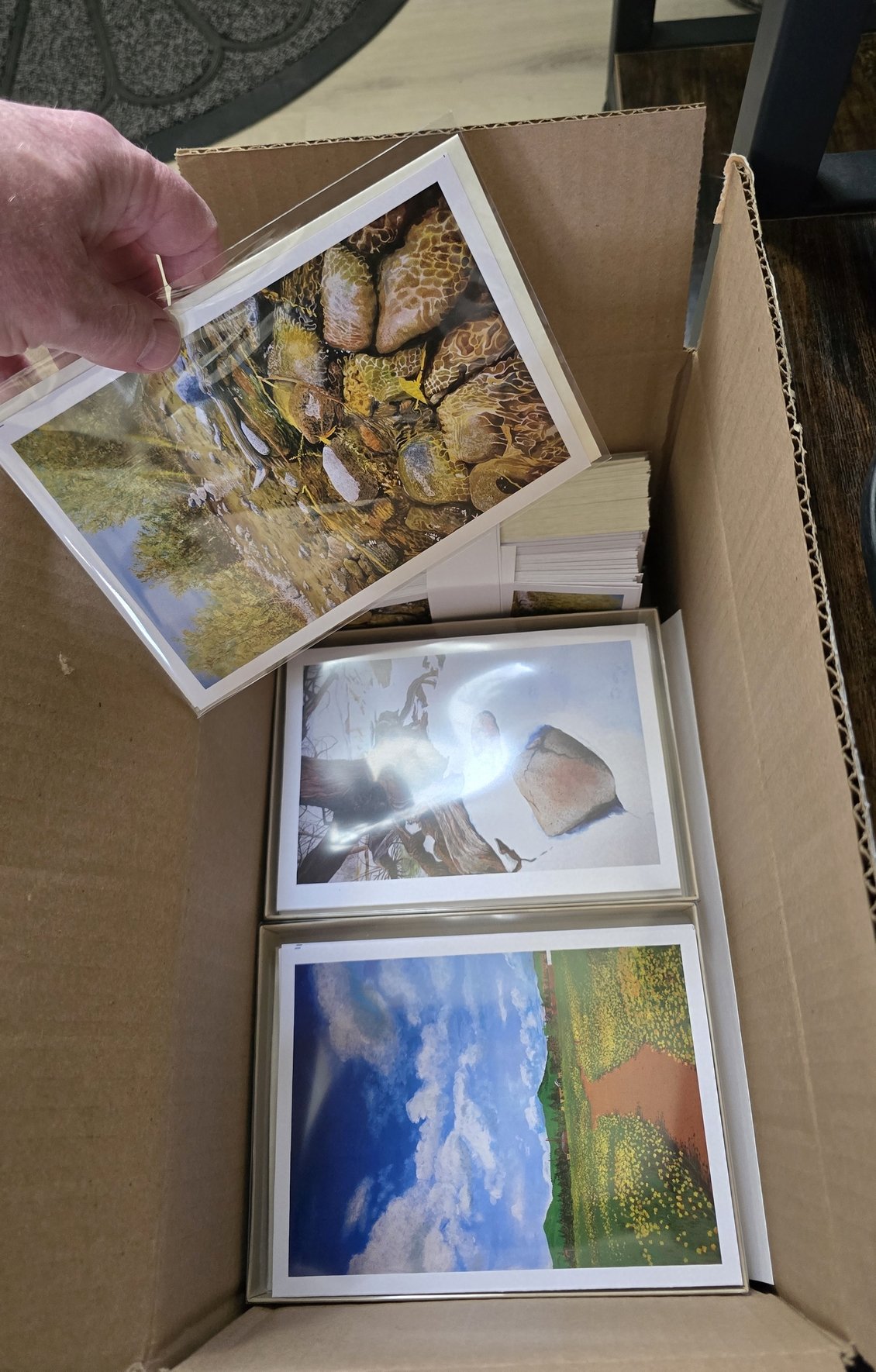
A couple of finished boxes, front and back…
The end of a long day: Packing up finished boxes and individual cards to take downtown…I’m donating 50 individual cards to the Prickly Pear Land Trust to use as thank-you cards to their donors, plus the cards I printed to sell. $5 for an individual card, or $35 for a box of nine cards, all with mailing envelopes…. at Omerta Arts, or buy directly from me by using the contact page of this website. The original paintings are on the “Landscapes - Tenmile Creek Park” page of this website.
3/24/2026 and 3/31/2026: As part of the Holter Museum’s “Courage to Create” program for veterans, we began learning to do some Chinese ink calligraphy / painting. A few of my practice pieces from last week (the 24th) and today below:
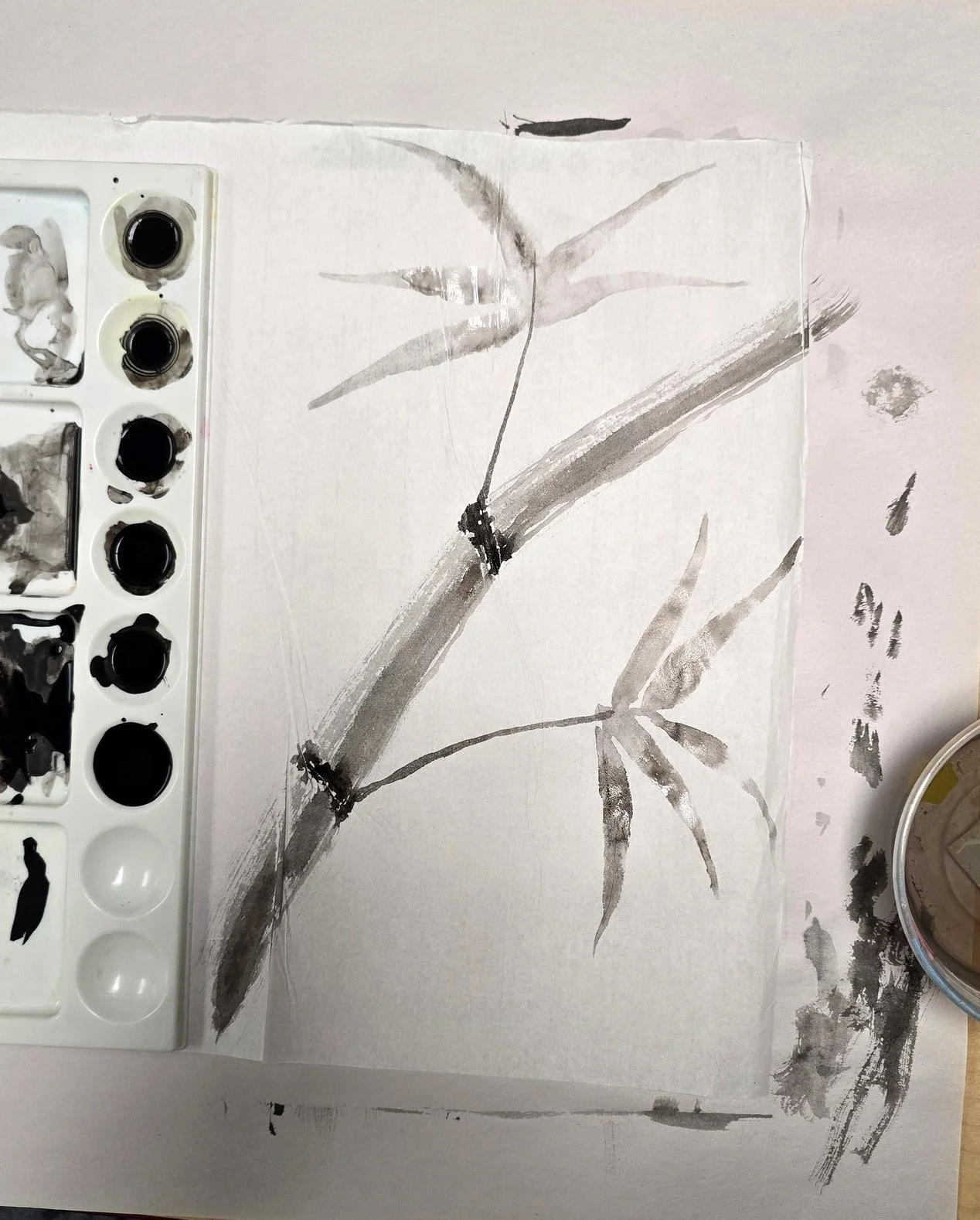
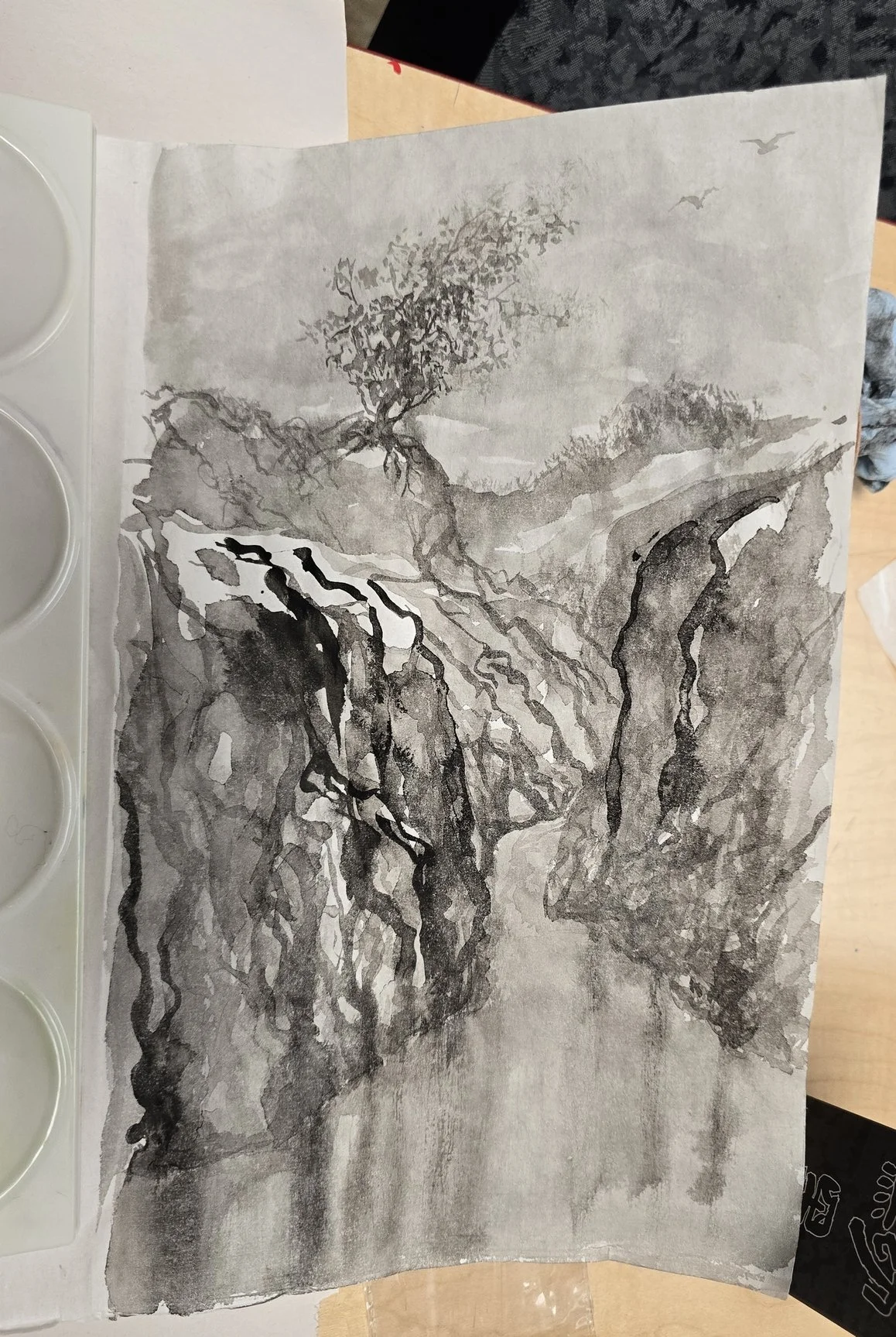
I’ve decided that I like this medium - it rewards working fast with a looser style that I’m really used to. Expect to see more of this on my page! A reminder that any veteran can participate in this series of events!
I’m also going to post several of my really old pieces, along with some pieces my parents did back in the day, over the next little bit. Here’s a teaser: I drew the design for this T-shirt for the Leaf and Bean coffee shop in Livingston, MT (located where the Perk on Park coffee shop is today; the building is much the same) sometime back in the very early 1990s… I don’t recall exactly when. That was back when most T-shirt designs were done by hand instead of by computer. I found it a couple of days ago while Digging through some old T’s that are destined to become rags.
4/14/2026: I’ve mentioned a few times in this blog that I have some catching up to do… I’m not a very good blogger, I guess (or web designer, for that matter)… so since I have a little time this evening, I thought I’d go through and see what all from the Holter Museum of Art’s “Courage to Create” program I never posted. That program is free to veterans, active duty, reserves, and veterans’ caregivers, thanks to grants from the NEA and (um) I forget who else. If you’re a vet in the Helena, MT area, you should feel free to drop in, any Tuesday from 1000-1200 and/or Thursdays from 1700-1900 (that’s 5-7 pm for anyone who’s completely over their time in service!). It’s a drop-in-when-you-can, zero-pressure environment, a chance to express yourself creatively (even if you’ve never done any art whatsoever before) and, in a way, a social club for vets. We have covered quite a range of materials and techniques, with a new ‘adventure’ every couple of weeks. I’ve posted some of what we’ve done previously in my blog(s), but I’m kind of delinquent, so… Here’s a drawing from our very first session, when the Holter’s Executive Director Christina Barbachano had us all draw a sphere, just to show us all that we could in fact learn to draw. Reflecting my sense of humor, mine comes complete with the spider, a bird out the window, and is signed “Bob Ross”.
The following week (this would be way back in September), we experimented with the different “hardness” grades of pencils, from 6B (softest) through the standard of #2 to 4H (very hard). If you look closely, you can see in these quick drawings where I’ve labelled which pencil was used for each part…
For the past couple of weeks, we’ve done artistic papermaking (recycling old paper). We start with shredding old paper and soaking it in warm water until the fibers begin to break apart. To accelerate the fibers separating, you can use a blender… if you have a blender that you’re willing to dedicate to that purpose. Our facilitator had some wads of partially 'disintegrated paper ready to go to save time (below). You can see a few of the screens (called ‘deckles’) used to sieve the fibers into a sheet of paper in the background, along with a tub of fibers… a couple of sheets have been pressed onto a bedsheet rag sitting atop a towel; those are the brownish gray squares by the hands. Finished paper sits just to the left of that.
In this pic (below), there’s a tub of orange-brown fiber ready to be re-made into paper in the background, a couple of sheets from that tub to the right, and some paper sieved from a different tub in the foreground. Leaving bits and pieces of the original paper gives it that interesting texture. You can also add ‘inclusions’ such as bits of feather, or press your sheet against a mould of some sort to emboss it with a texture. It winds up far more interesting than your ordinary sheet of say, copy paper!
The new wet paper sheet takes quite a while to dry, so we put them on cardboard where they’ll stay for a few days… I used a ‘deckle’ dipped into three different tubs of fibers to make this green, yellow and purple sheet (below). Nothing I’m going to frame or hang on my mom’s refrigerator, but still, it’s pretty cool… and the paper some of the other vets made is probably frame-worthy!
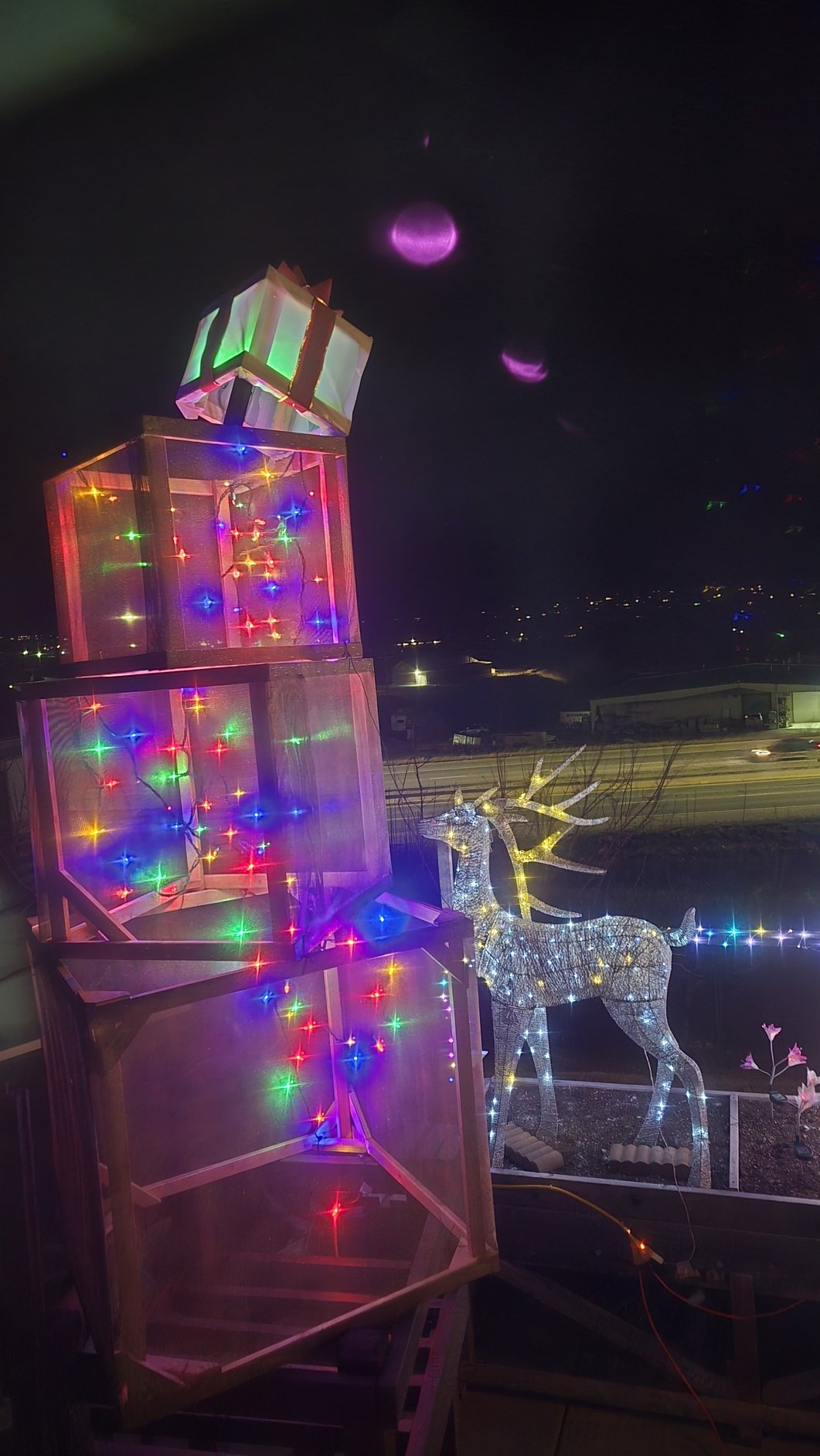
Creativity can be expressed in many different ways… From back in December, here’s a decoration I made from 1×2 frames and gold-glitter-painted window screen. My wife had seen a commercial ‘stack of presents’ decoration at our local Lowe’s hardware store, but it was way too small to be visible from the road beneath our house, so I made a much larger one (about eight feet tall). Looks OK from the window, and great from the road. The “reindeer’ behind it is a commercial purchase from, you guessed it, Lowes; it has its antlers askew due to a recent windstorm. I maintain that whatever you do can be a way to express your creativity, and thus an ‘art’; this is just another example of what I do… plumbers, cabinet makers, architects and lawyers can all be artists at what they do. Your creative outlet is up to you…
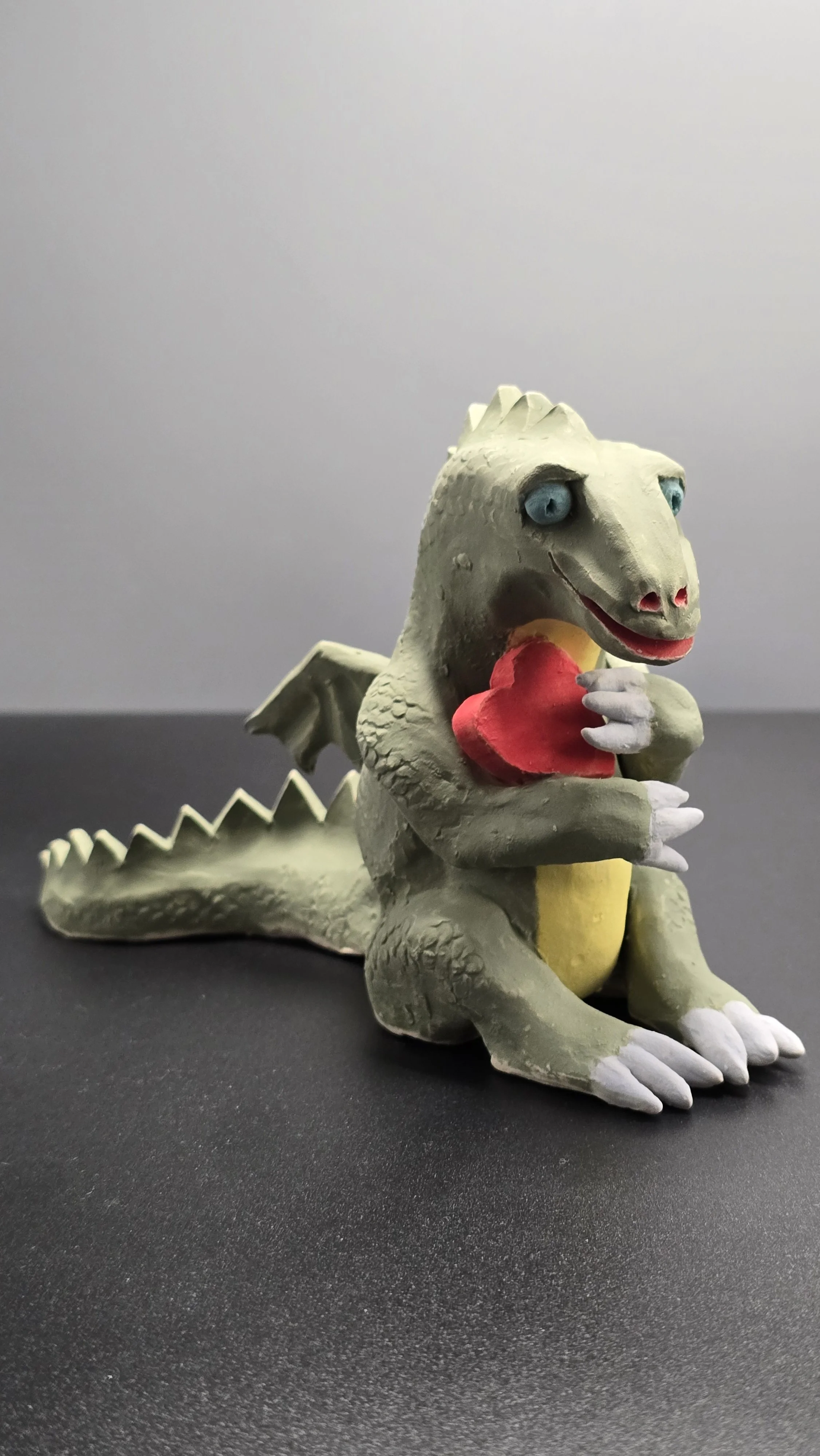
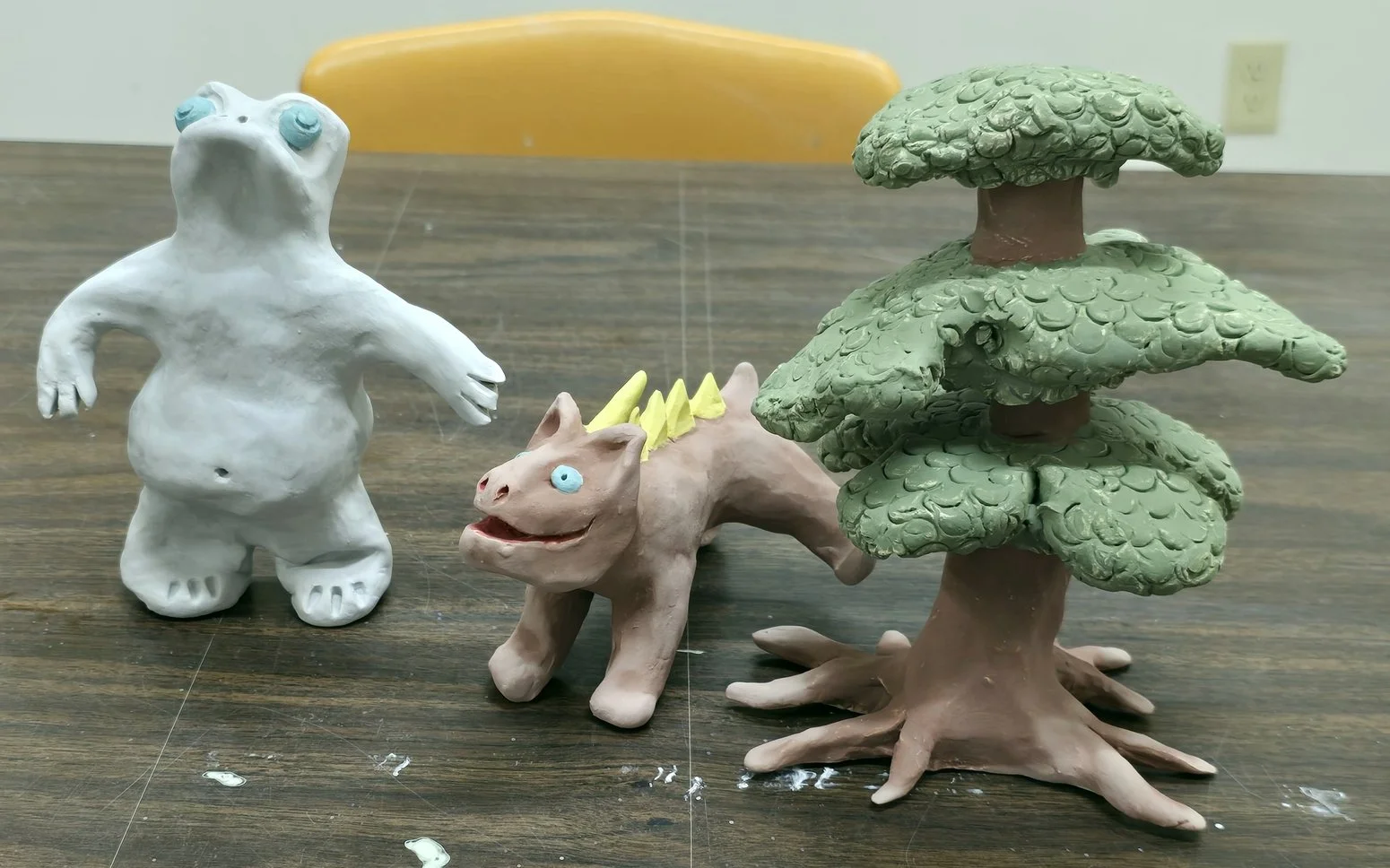
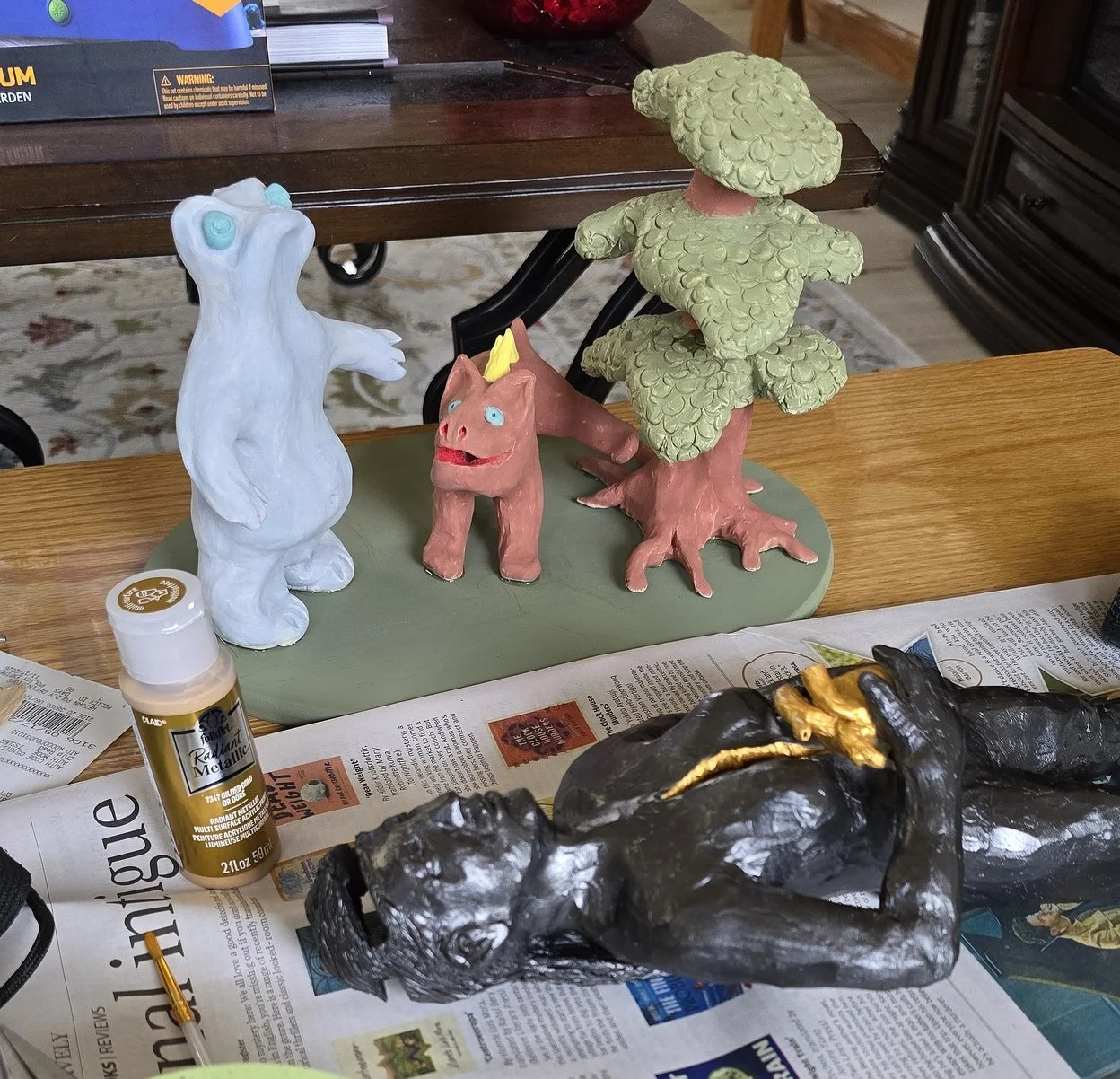
My final update before I give up for the night is from a different veterans’ arts program. Omerta Arts in Helena received a new grant to work with veterans on clay sculpture. As you know from this blog, I’ve done a fair bit with clay at Omerta… here are my latest creations, drying in preparation for the kiln. A funny tableau of odd creatures inspired by Dr. Seuss, and another Fat Happy Dragon holding a heart (next two pics). I’ll try to get around to posting more “catch-up” blog entries tomorrow!
4/27/2026: Spent last weekend rehearsing with and then playing with the Butte Symphony… it was a great concert! My favorite piece of the show was “In the Steppes of Central Asia” by Alexander Borodin.
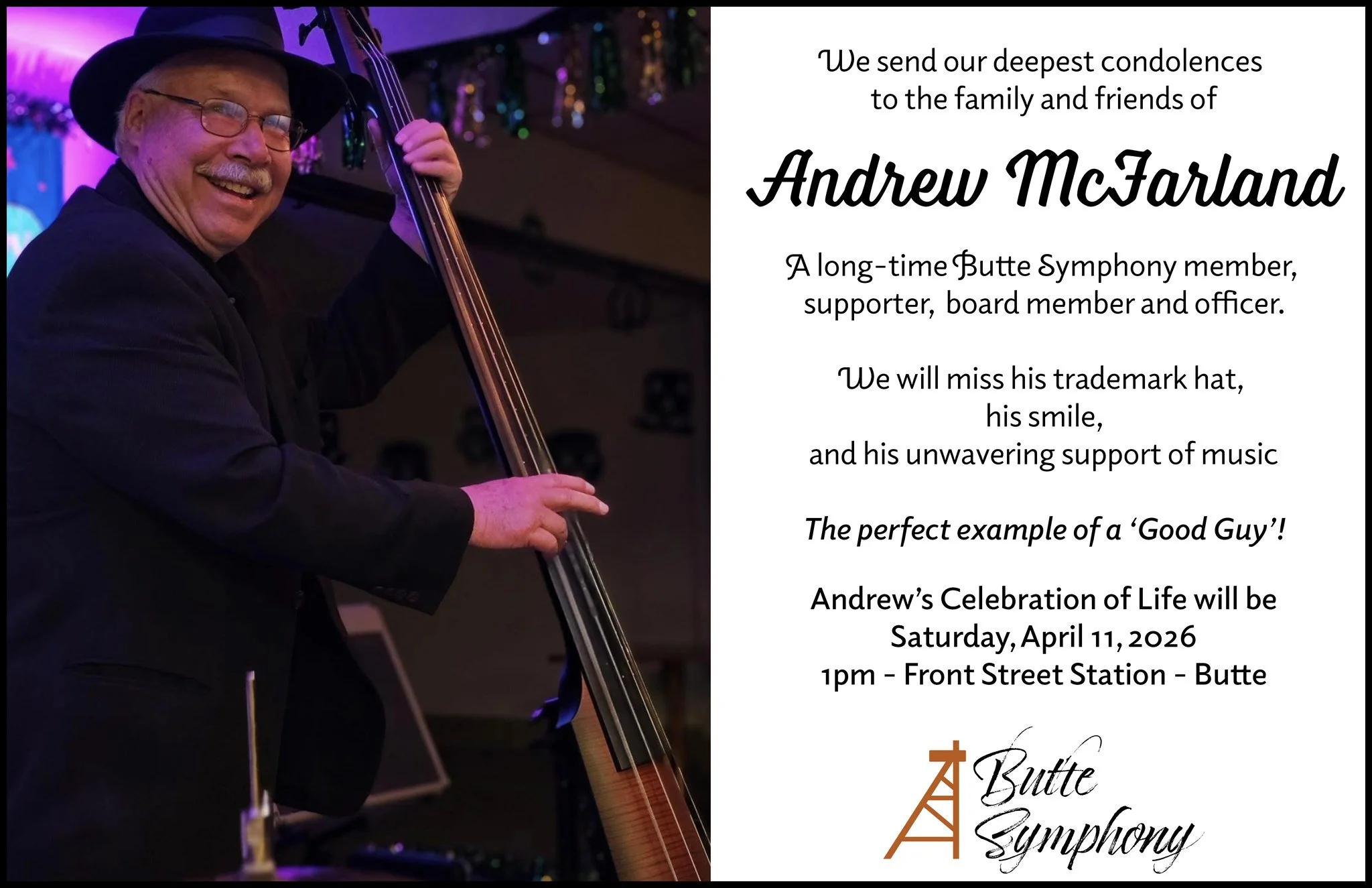
We set up a tribute to the late Andrew McFarland, who played bass with the orchestra for many years. His bass, trademark hat, and portrait were placed, spotlighted, to one side of the Mother Lode Theater, with a rose placed on top… he was one of the good guys. RIP.
If you want to hear the Butte Symphony for free, on July 29th we’re doing an outdoor concert in Stodden Park (Butte, MT of course; from 5:30 to 7:30 p.m.). Not enough free Montana outdoor classics for you? the Billings Symphony’s “Symphony in the Park” is June 28th in Pioneer Park; Helena Symphony’s annual “Symphony under the Stars” is July 18th on the Carroll College campus; and the Missoula Symphony has “Symphony in the Park” in August in Caras Park (Their “Symphony on River with [the band] Lettuce” is NOT free, so ignore that one… Also not free: Glacier Symphony [Kalispell] at Rebecca Farm on July 3rd).
BTW, trivia: the Russian title is merely “In Central Asia” without any mention of the Steppes… the piece is supposed to musically depict a caravan of Central Asians traveling across the great dry grasslands of the steppe. Borodin wrote “In the silence of the endless steppes of Central Asia is heard the unfamiliar sound of a peaceful Russian song. From the distance we hear the approach of horses and camels and the exotic and melancholy notes of an oriental melody. A caravan approaches, escorted by Russian soldiers, and continues safely on its way through the immense desert. It disappears slowly. The notes of the Russian and Asiatic melodies join in a common harmony, which dies away as the caravan disappears in the distance.” The English horn solo represents the Asians; the pizzicato rhythm represents the hoofbeats of the horses and camels; and the forte brass-heavy theme the Russians. It’s dedicated to Franz Liszt, and the premier performance was conducted by Nikolai Rimsky-Korsakov way back in April of 1880… talk about musical connections!
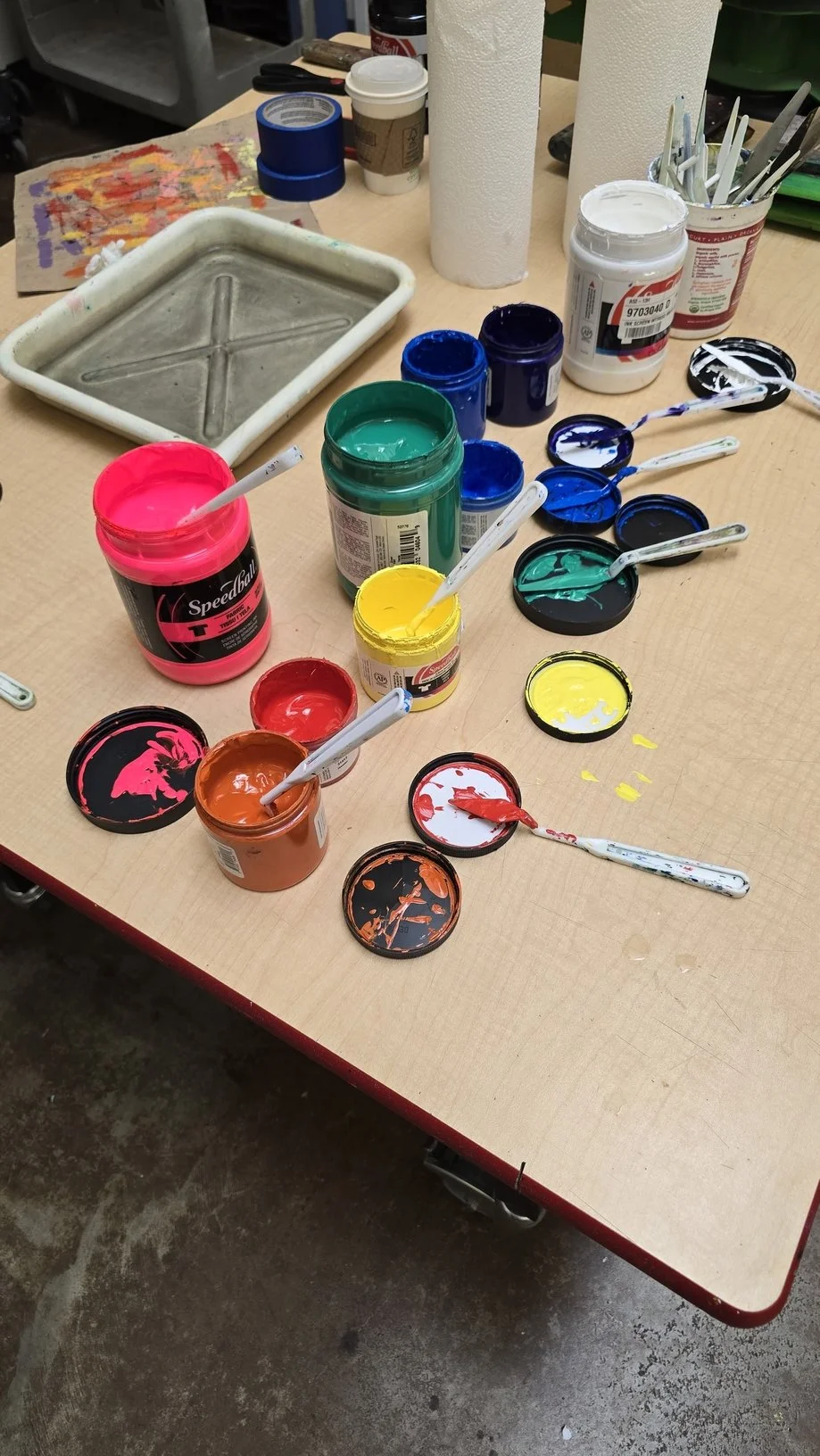
6/21/2026: It’s been quite a while since I posted to this blog… and boy, have I got a bunch to catch up on. I’ve been busier than a toddler with a marker, a freshly painted wall, and a mission. Much of what has been going on is not related to the arts - dealing with a relative who had yet another medical emergency, dealing with my own medical emergency (seems my ticker is overly excitable — not to worry, for now I’m fine), some necessary deferred maintenance for the house, spring stuff, i.e. helping my honey set up her gardens, complete with automatic watering system, rain barrels, rolling flowerpot racks, new raised beds, etc. etc. Because I’ve been sitting on these blog updates for so long and my memory is so short, I can’t guarantee that I’ve got the sequence right for all the things below! I’ll start with 28 April… as I’ve posted before, the Holter Museum of Art has been running an arts programs for veterans (titled “Courage to Create”, a title which quite frankly makes me cringe, but one that probably sells well to those who apportion grant money - and without funding, there’s no program!). Our 28 April session was an introduction to silk-screening, using tote bags. Because it was an intro and we are time limited (we meet from 10:00 to 12:00 a.m. on Tuesdays), we used pre-cut screens which we stenciled onto a background we painted. Step one, of course, is choosing your colors (below).
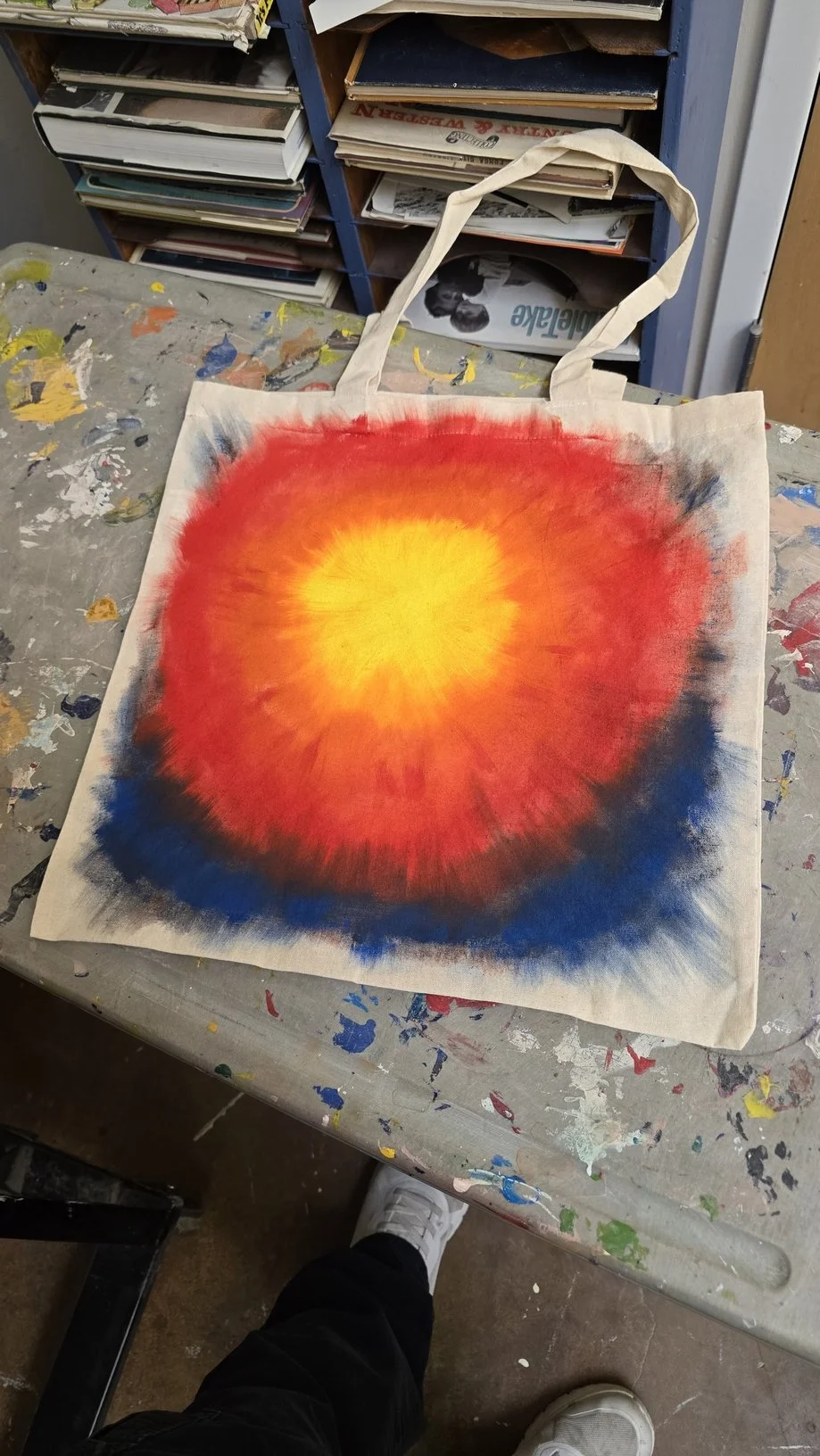
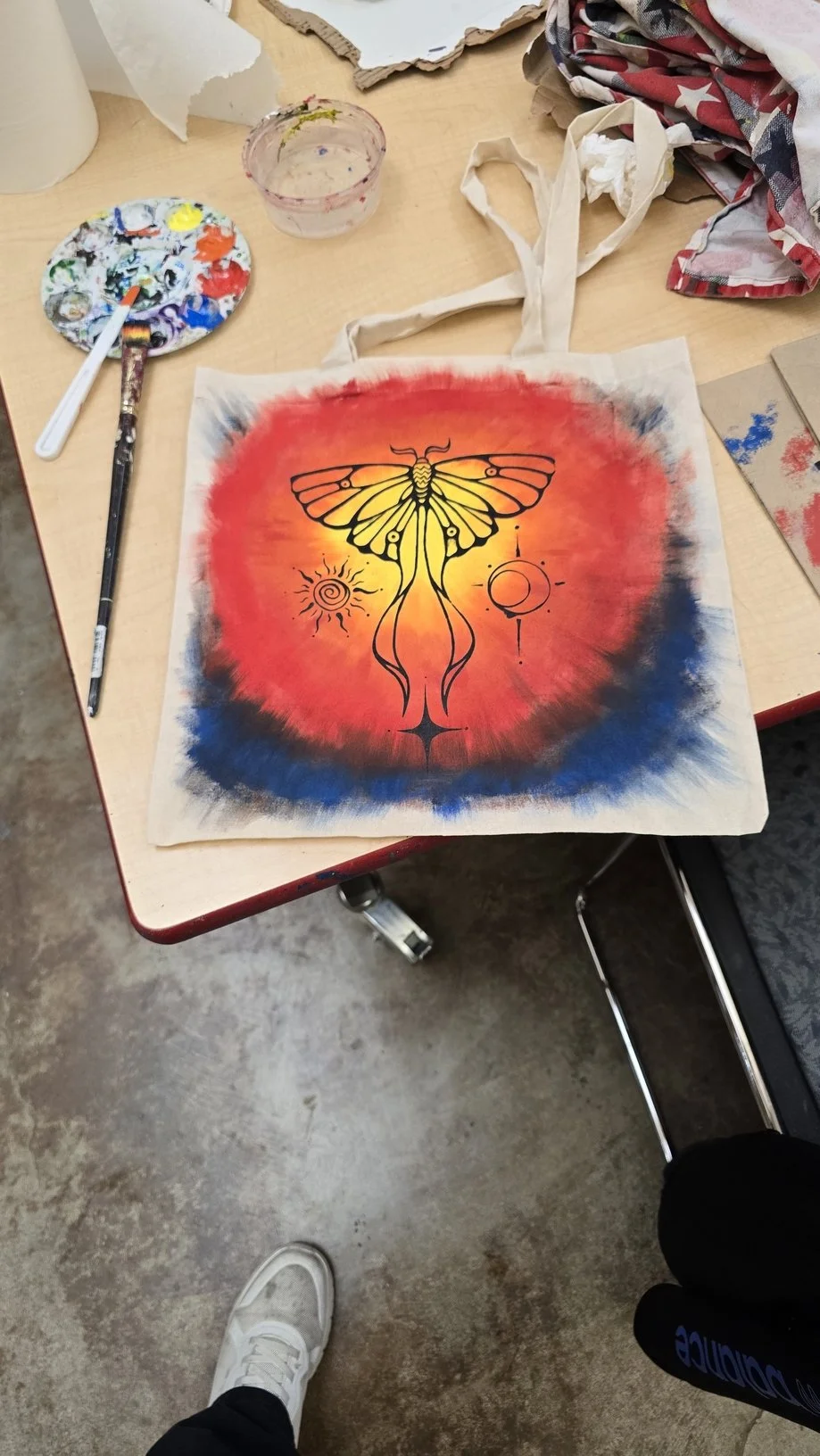
I chose to paint a sunburst color scheme on my tote. While painting, I had to slip a sheet of cardboard into the bag so that the paint wouldn’t soak through the fabric to the other side (below). The paint (or ink) we used must be ‘set’ with heat before stenciling on the design.
Next, we made sure that the stencils / screens we used were taped off so that we wouldn’t get any fabric paint outside the edges of the intended design… the screens are traditionally made of silk, thus “silk-screen”, although most use synthetic fabrics now. The design can be applied to the screen several different ways, but the key is that wherever you want to print, the screen is left open, and wherever you don’t, the stuff you’re using blocks the screen to keep paint from going through. I’ve seen several different materials used to block the screen, to include photo-sensitive gel, hand-cut stencil gel, and even lightweight paper… but in every case, the objective is the same: make a stencil.
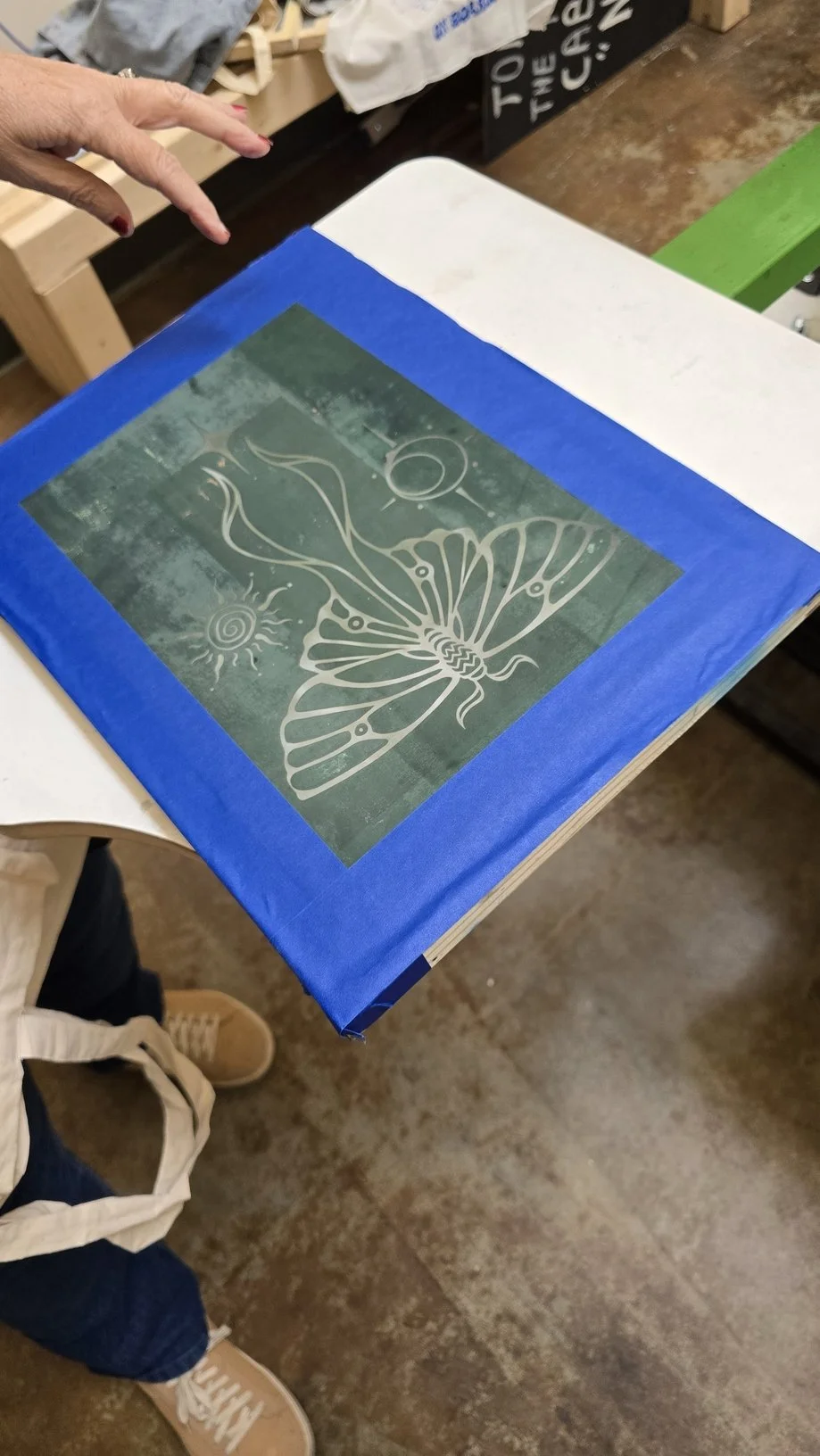
The screen is loaded into a device which will ensure that the design is aligned with (“registered with”) the object on which you’re going to print… this is especially important for multi-color designs, which must be printed one color at a time. The Holter has a nifty contraption which enables registration of up to four colors. We were only printing one color, of course (below).
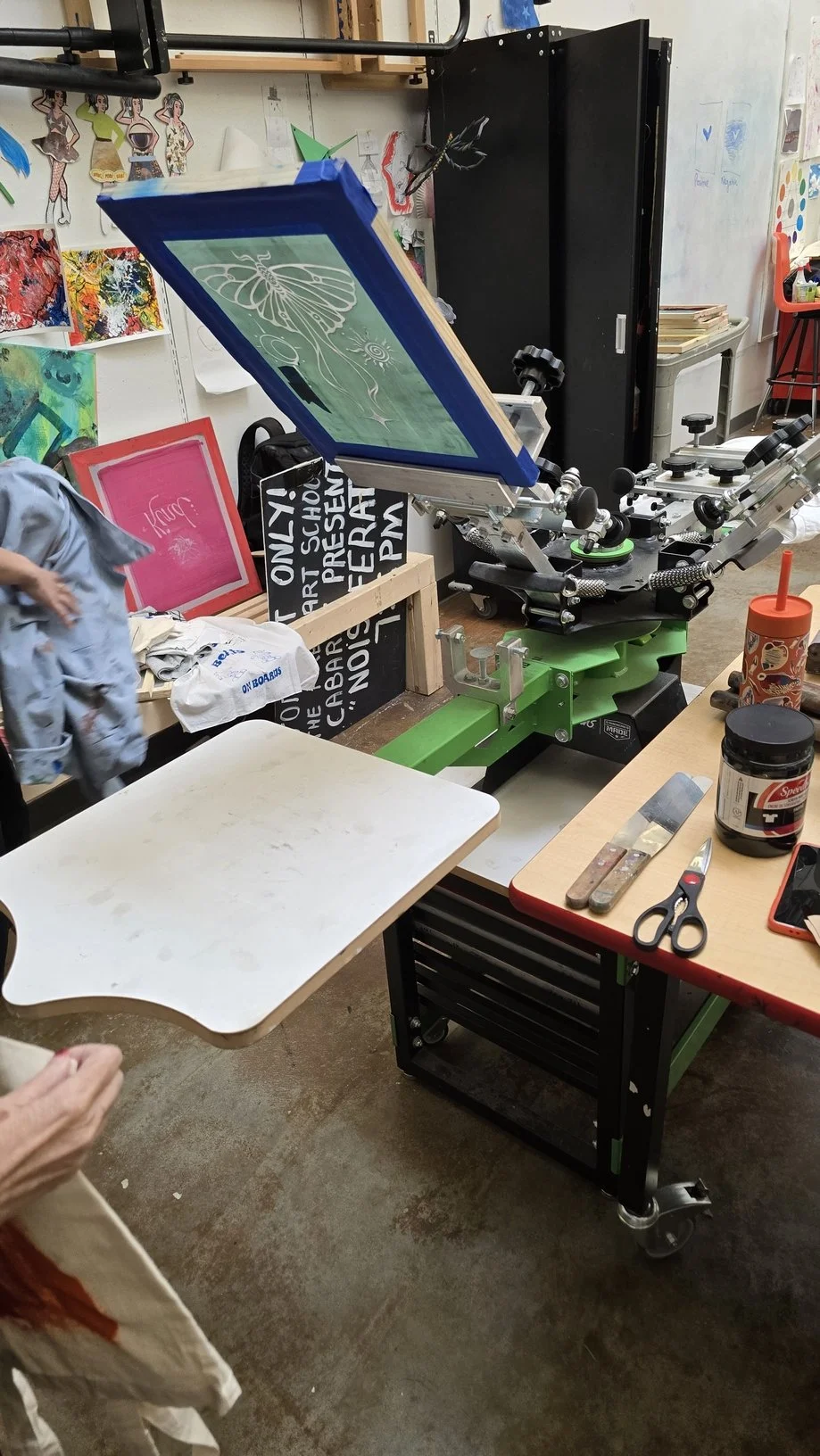
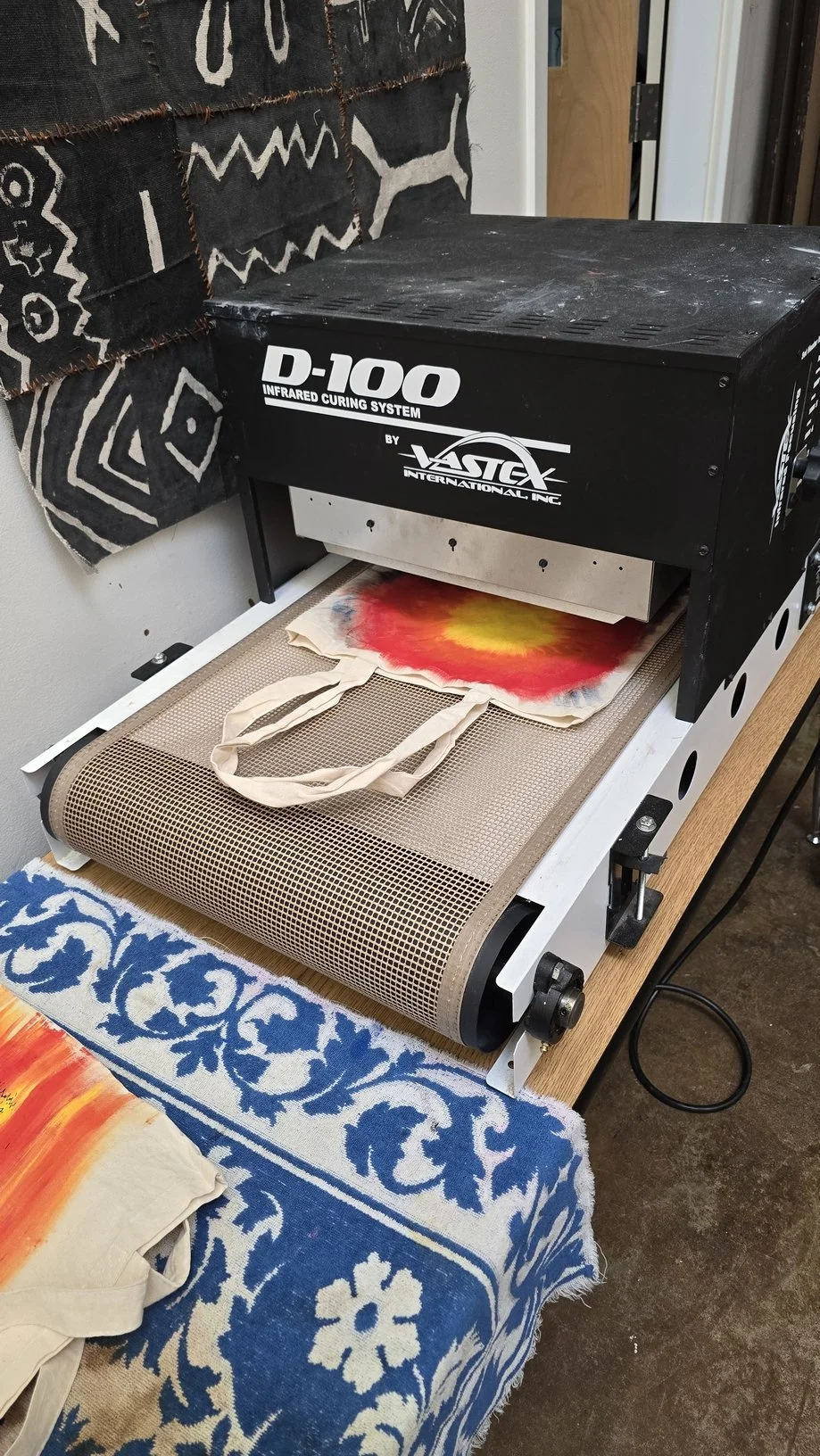
Typically, you use two strokes across the screen with a squeegee. The first ‘floods’ the color into the screen, and a second, using more pressure, presses the paint through the screen and into the fabric. Once the design is applied, it also must be ‘set’ with heat. The Holter recently purchased an upgraded “infrared curing system” to set the paint (or to some, the “ink”). It rolls the item through on a conveyer - and our facilitator was very happy that unlike the previous one, this one doesn’t accidently set off the smoke alarms!
And here’s the finished product! The tote came in handy to lug my stock of greeting cards out of Omerta Arts the next week (only temporarily!) to make room for the Montana Watercolor Society’s ‘Members Show’.
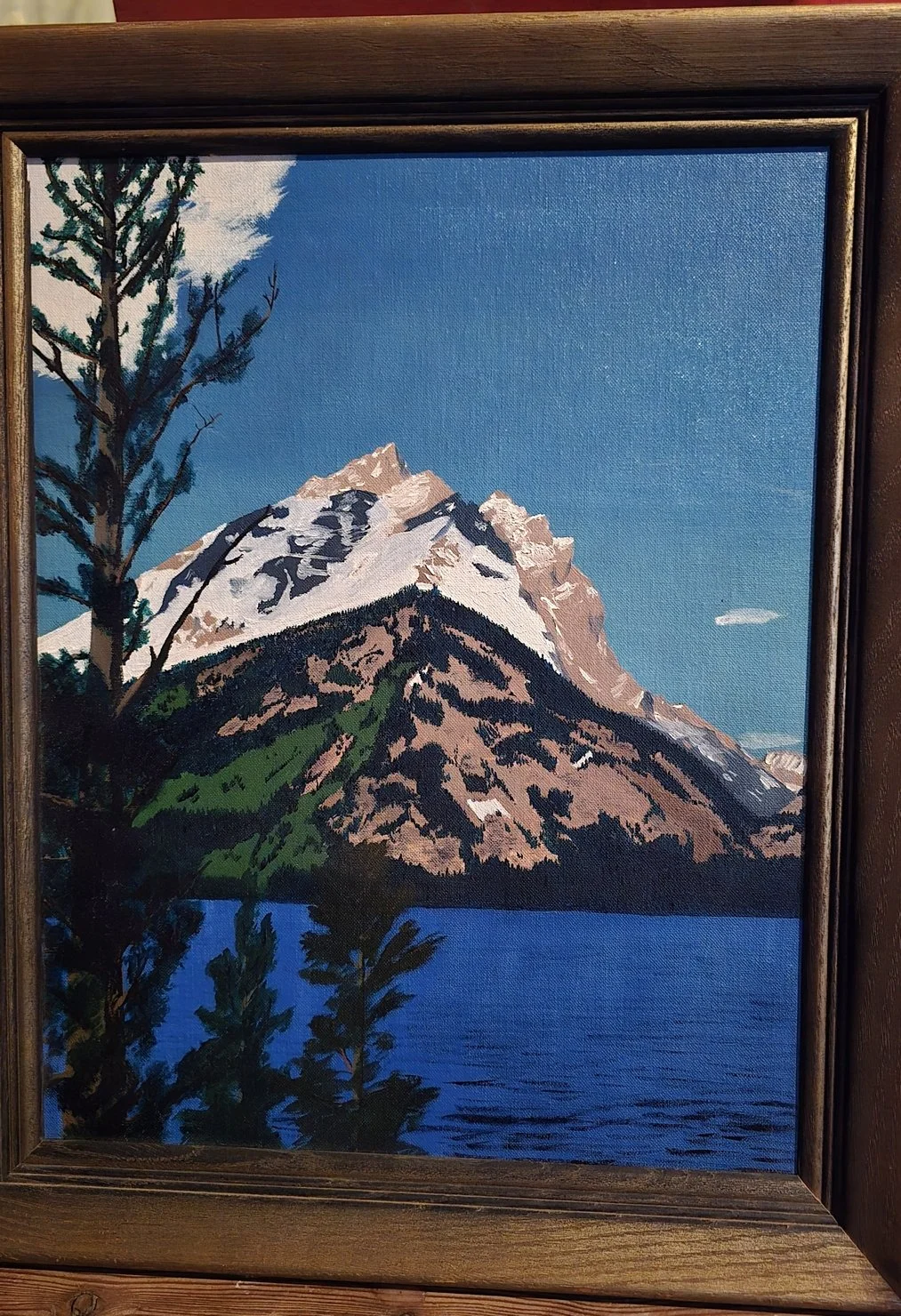
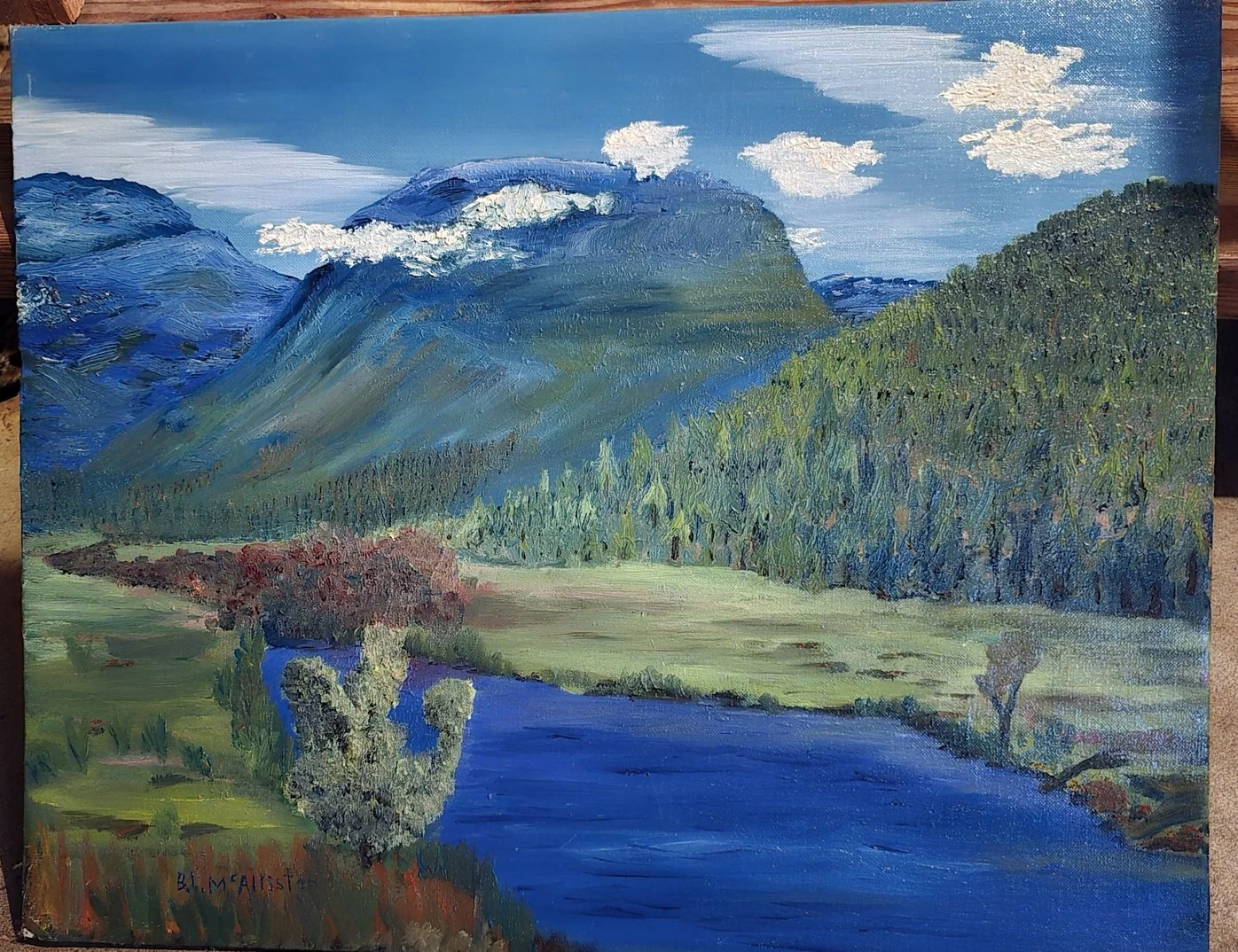
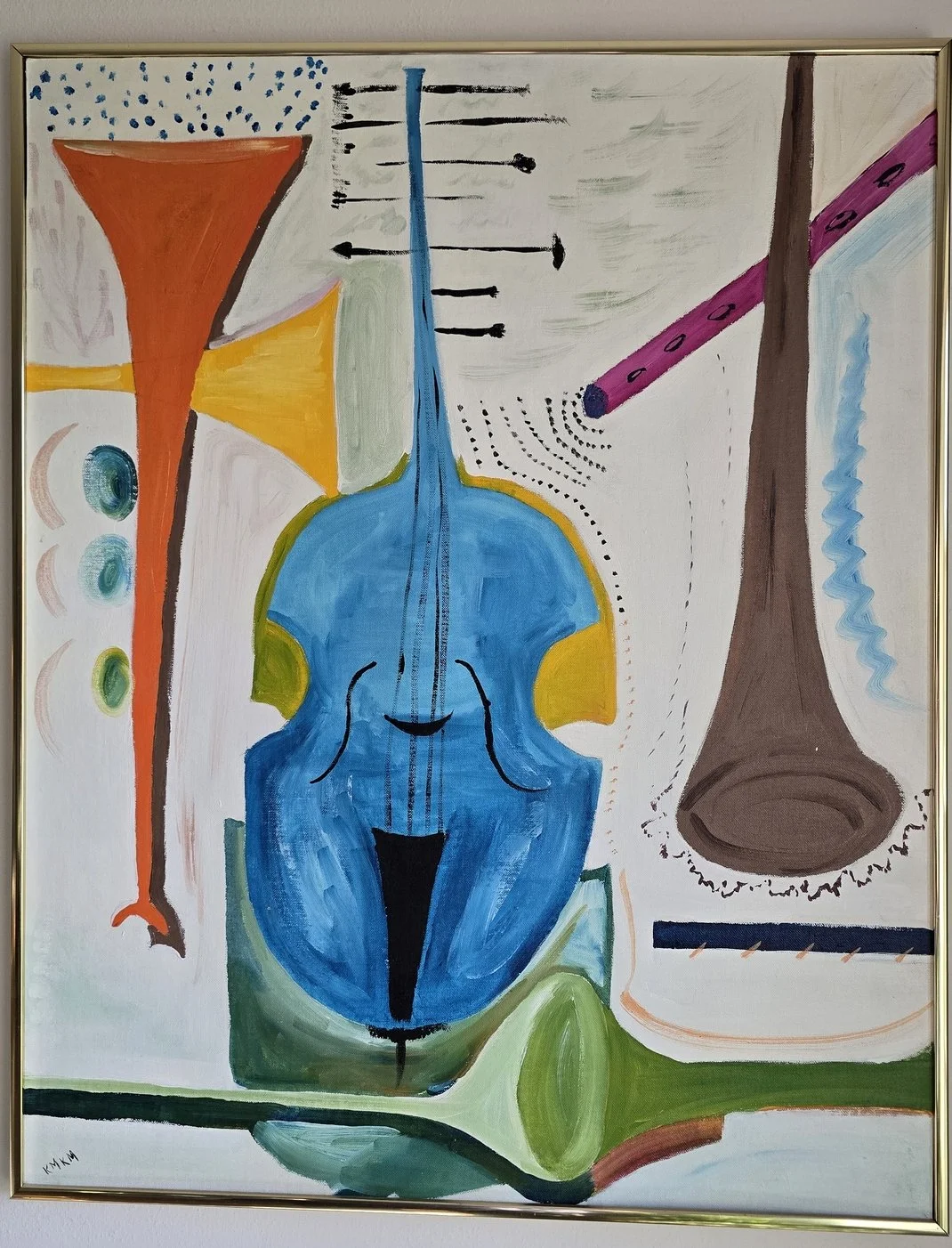
Shortly after this session, I wound up back down in Bozeman to help a relative with a medical emergency. While there, I stayed in my mother’s home. It was also mine growing up, and even on and off for a few years in adulthood. I snapped a few photos of paintings done by my late father and my mother. I like to think that at least part of what I’ve learned about making art comes from my parents… Below are three paintings done by my dad….
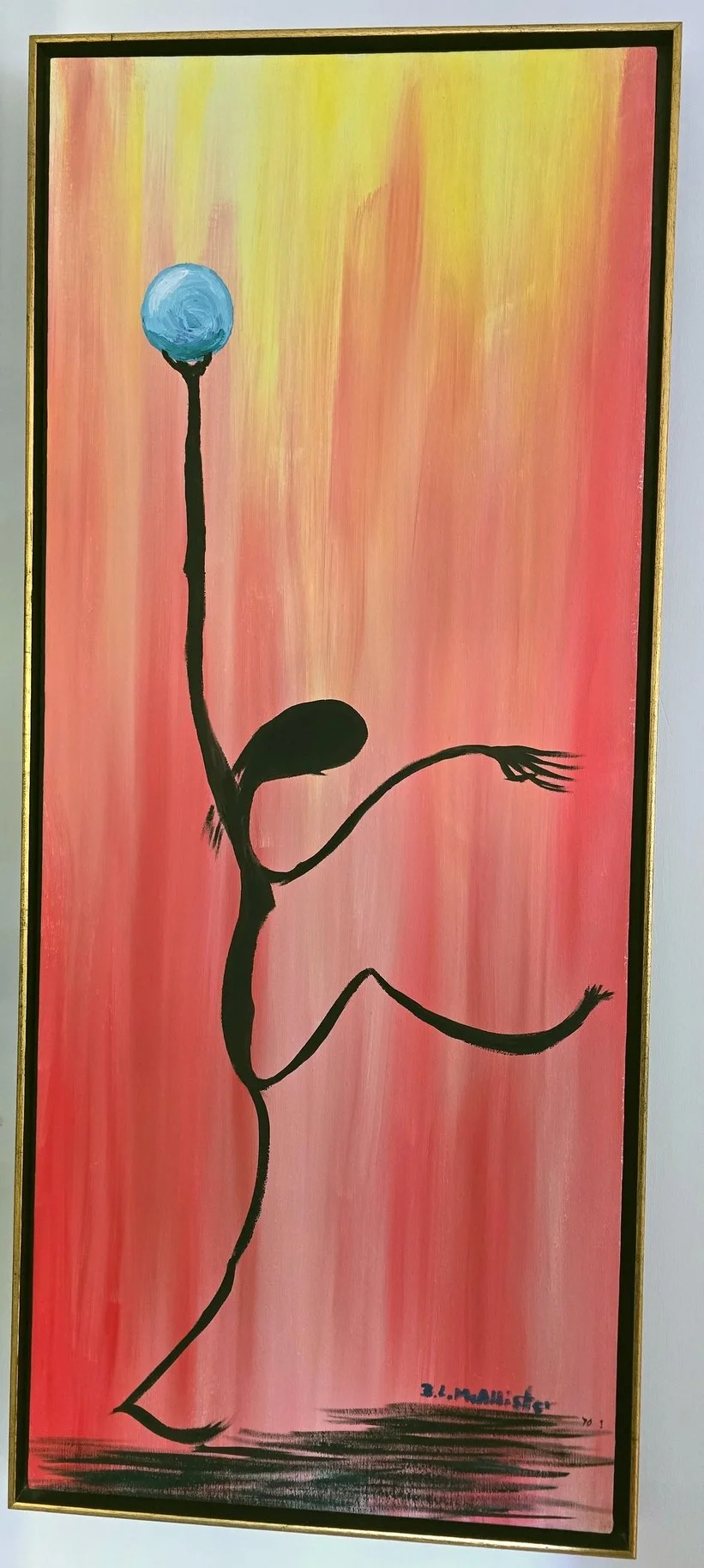
…And two painted by my mom (below):
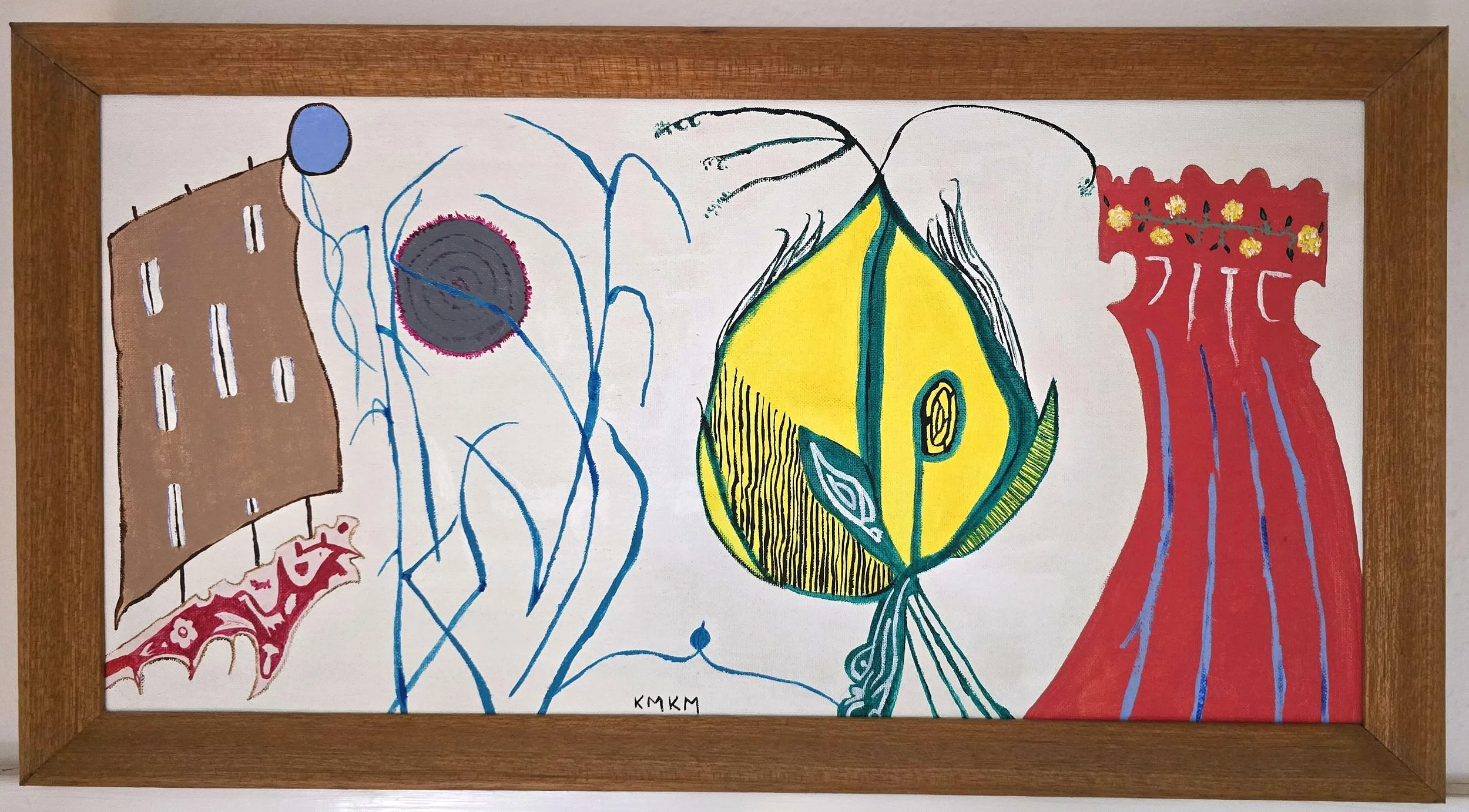
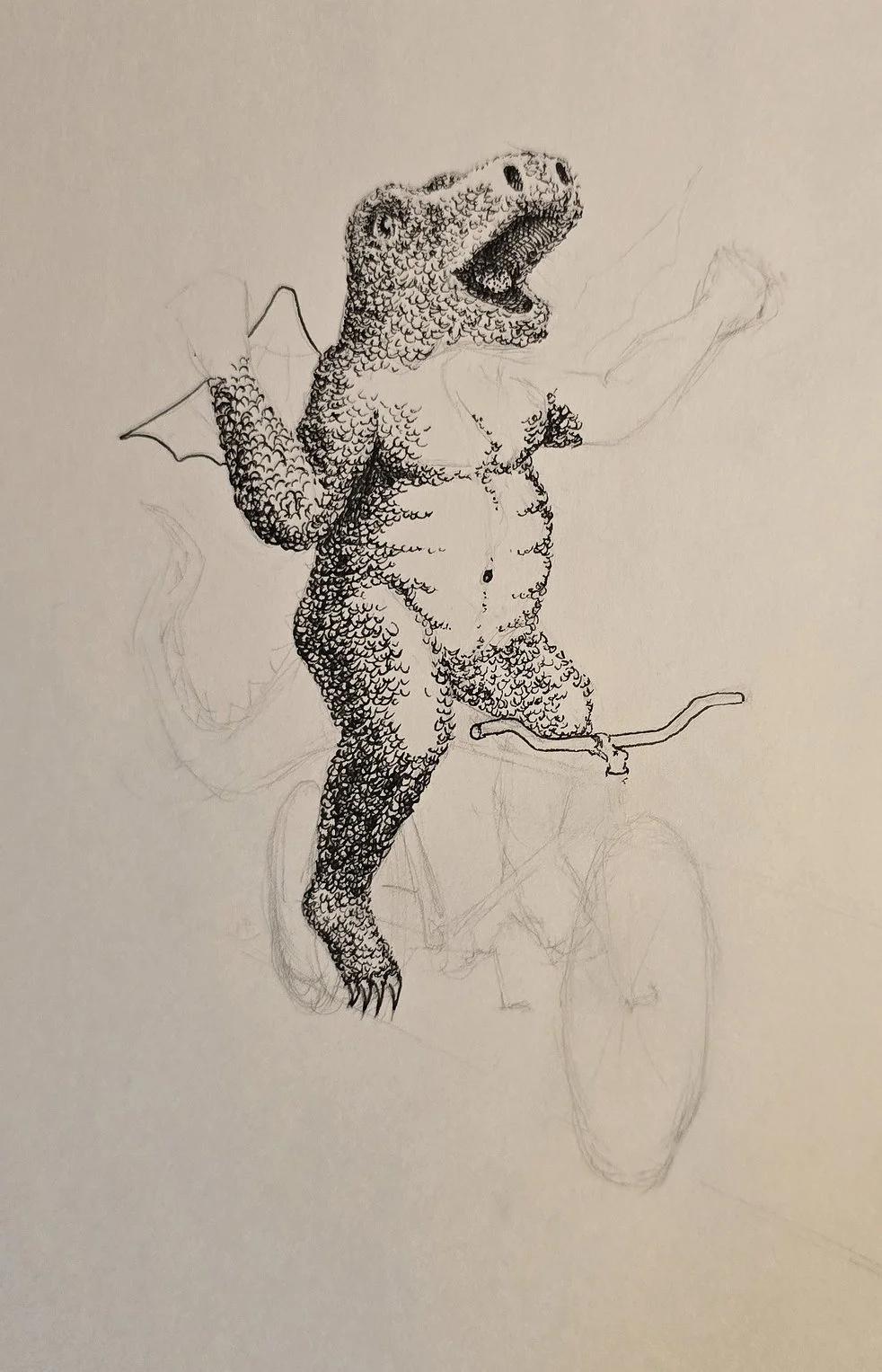
I also started another “Fat Happy Dragon sketch - this one has the dragon riding a bicycle. I typically sketch these out in pencil first, and once I’m happy with the sketch, I start inking with a technical pen. When the ink is dry, I erase the pencil out from underneath. This drawing was set aside when I returned to Helena, but I intend to finish it this week. Here it is thus far:
Somewhere in there, I found time to visit the Montana Watercolor Society’s ‘Members’ Show’; it runs through Friday June 26th, so there are still a few days left to see it. It’s a great show of work by mostly amateur artists who belong to the society. If you’re in Helena, drop by the Omerta Arts Syndicate (800 Front Street in Helena, open Wed.-Sat. 11:00 a.m. to 6:00 p.m. and irregularly on Mon.-Tue.) and check out the show! (One of two rooms filled with the society’s art, below.)
6/2/2026 & 6/9/2026: For two of our veteran sessions at the Holter Museum of Art, I introduced the group to painting with acrylics as a Holtere “Teaching Artist”. For the first session, we just got familiar with the medium through painting a minimal still life with an apple and a block. Although I had examples of simple finished paintings as part of the experiment, there was no expectation that anyone would emerge with a painting they’d want to hang on the wall — although several participants did. My examples are below.
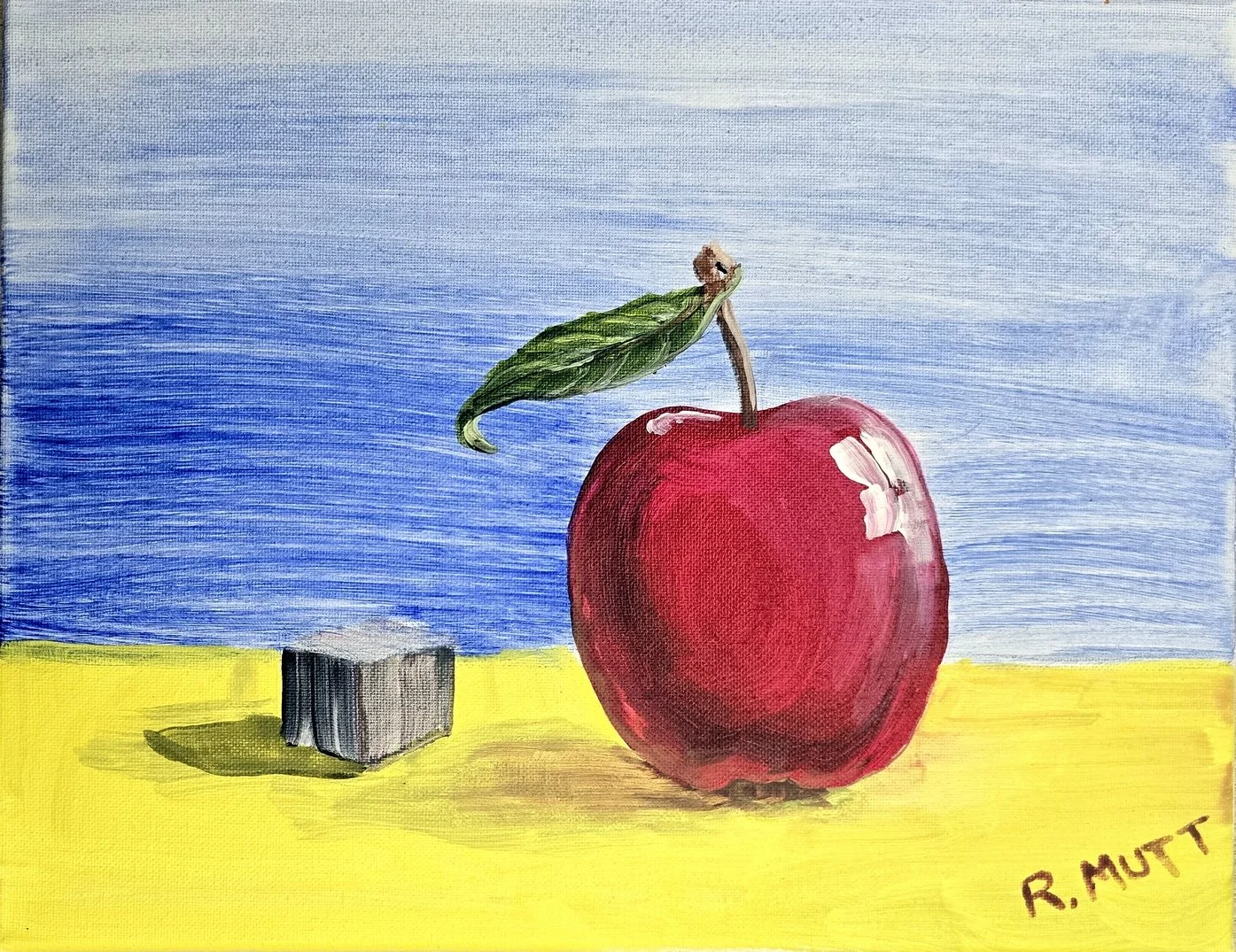
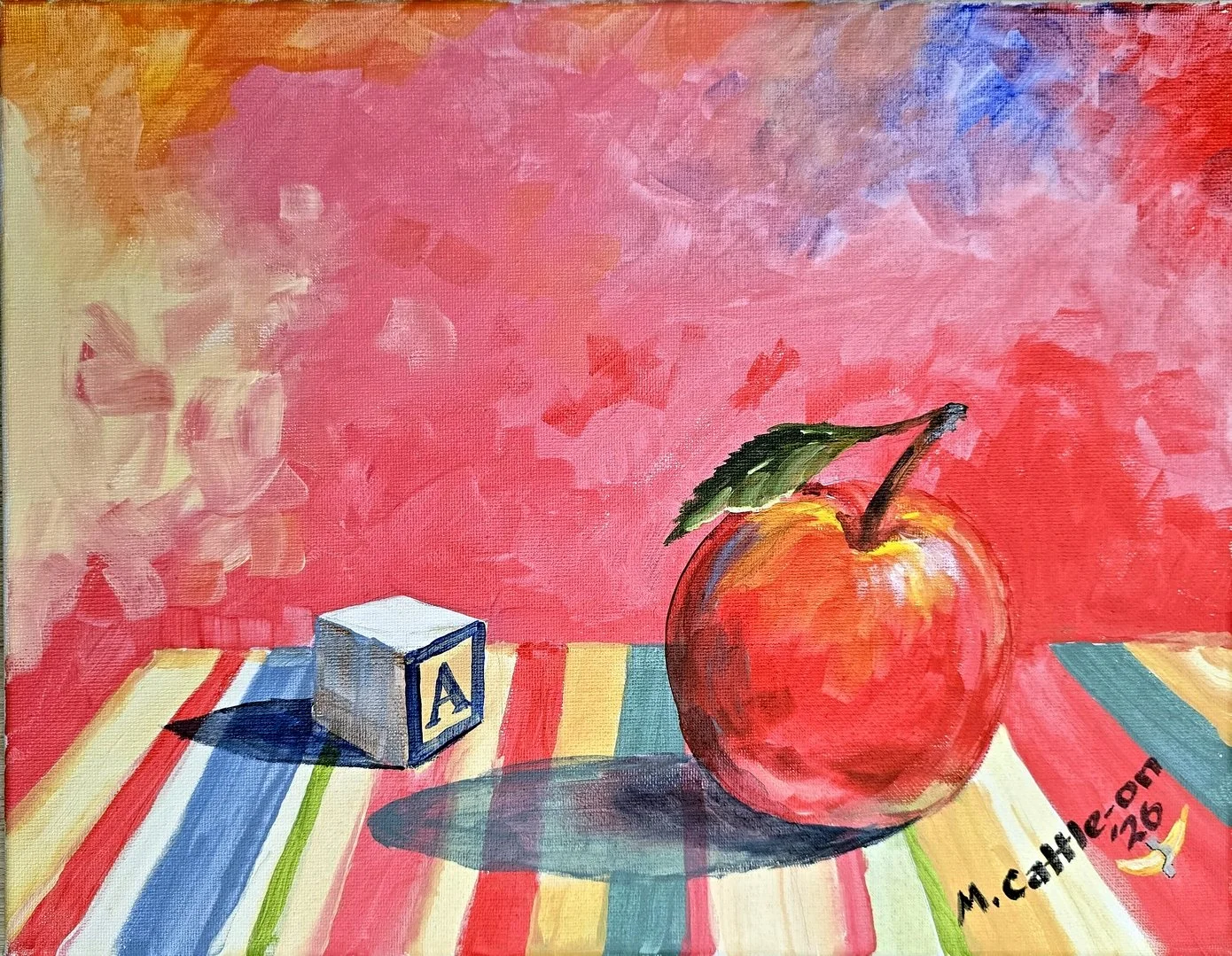
Since these aren’t meant to be marketable paintings but just examples for the exercise, I signed them with fictional names…. R. Mutt is a homage to Marcel Duchamp, one of the art world’s greatest comedians / innovators / scammers (depending on who you ask), who placed a urinal upside down in the 1917 inaugural exhibition of the Society of Independent Artists in the Grand Central Palace in New York and titled it “Fountain”. He signed it, of course, “R. Mutt”. It’s regarded by art historians and theorists as a major landmark in 20th-century avant-garde art; whether for good or for bad is up to you — as is the question of who really came up with it; there’s some debate about whether Duchamp or Elsa Baroness von Freytag-Loringhoven really came up with the idea.
M. Cattle-on is a play on Maurizio Cattelan, another joker / innovator / scammer (depending on who you ask) who achieved viral fame for duct-taping a banana to a wall and selling it (titled “Comedian”) for $120,000. Of note: the purchaser didn’t just get a rotting banana; they also got a certificate of authenticity and detailed diagrams and instructions for its proper display - including, of course, how to change out the banana. This work re-sold at auction for $6.24 million, demonstrating that “conceptual art” is… erm… well… you decide! Oddly enough, part of the fame of the piece comes from another artist eating the original banana, and the purchaser of the $6.24 Mn banana doing likewise…
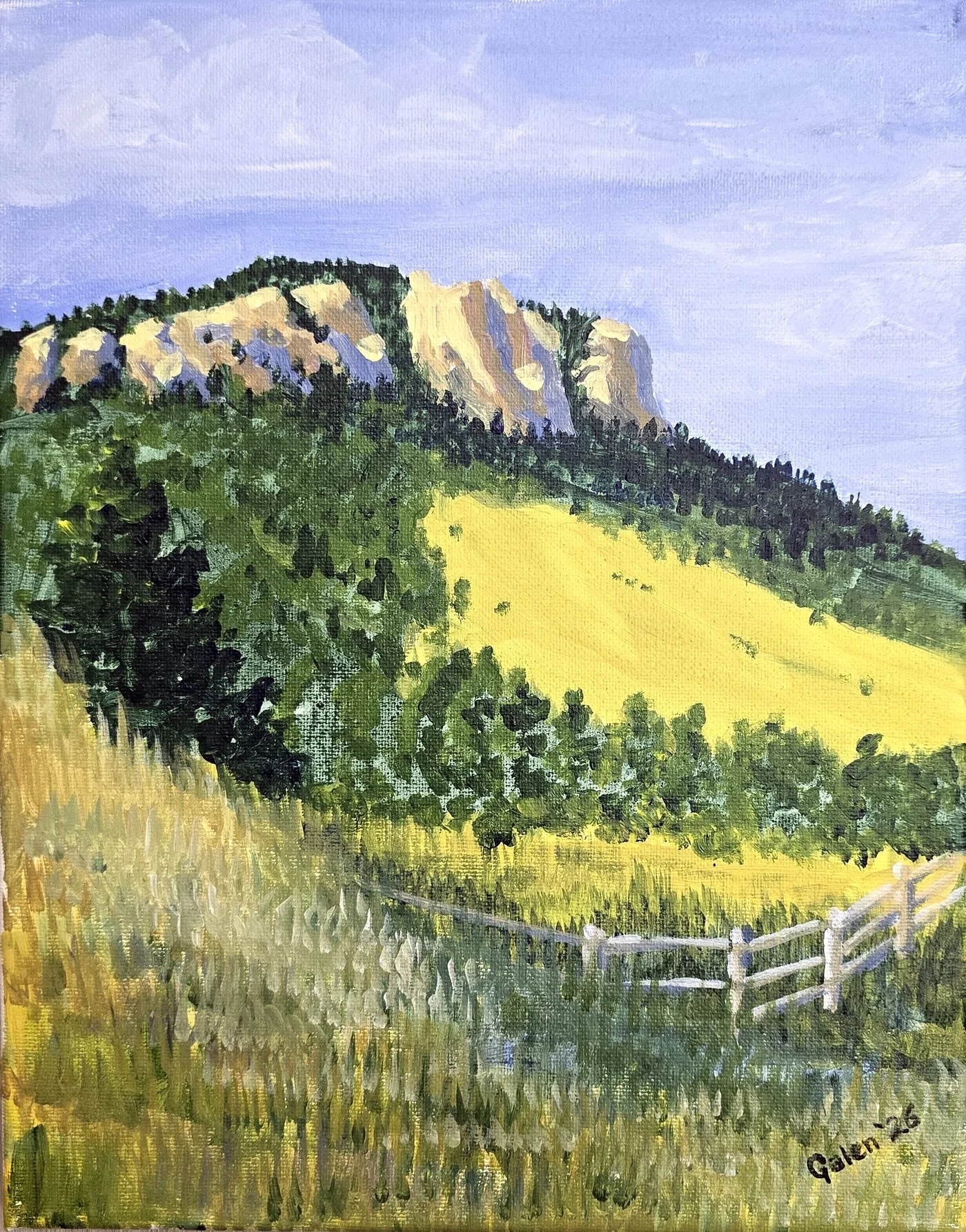
9 June 2026: at the second session I led on painting with acrylics, we upped the ante to painting a landscape that would be (hopefully) good enough to hang on the wall. I offered to walk through three different simple landscapes with the group. Unfortunately, I left the example that we started with — a sunset reflecting in a lake with evergreens silhouetted on the horizon - at the Holter, so I don’t have a picture of it. But in the closing minutes of the session, I also demonstrated some essential techniques for the picture below, a view of Mount Helena. Several of the participants took home a canvas with a lightly sketched outline as well as photos of the example below (we ran out of time to work on this one during the session). I painted it strictly as an example, but it came out well enough to be a finished work… so I signed it “Galen”.
Still 6/9/2026: After our session at the Holter, I wandered over to Omerta Arts, where I got that reclining nude back from the kiln. The glaze I used is called “Palladium”, although none that metal is actually used in the glaze. I think it turned out really well. Being extremely shiny and reflective, it’s very difficult to show it in a photograph. The photos below do give some idea, although it’s obviously better seen in person. If you look closely, you can see a very distorted image of me taking these photos reflected in a couple of spots.
10-14 June: Road Trip! I headed out to the Waterworks Art Museum in Miles City, Montana to take a dozen pieces to their upcoming show of Montana Artrepreneur Program (MAP) artists. The MAP was run by the Montana Arts Council (MAC) to encourage the further professionalization of Montana’s artists. It has been replaced by a new program, “Art Works”. Both are great programs; I highly recommend it for any aspiring artist.
The MAC says this about “Art Works”:
“Artists are, by nature, inventors, engineers, explorers, and discoverers. Artists see possibility everywhere. Monetizing talent, however, is a daunting task for an artist. At the Montana Arts Council, we recognize that creating a sustainable life in the arts is complicated, that there is no singular approach to building a creative enterprise, that it doesn’t happen quickly, and that success has its roots in relationship-building. With a mission to help artists build a sustainable life in the arts, we provide a program to Montana artists called Art Works.”
It’s 385 miles (620 km) one way from where I live in Montana (yep, it’s a big state), and I’m not as young as I used to be, so I broke the trip into two parts with a stop in Billings, MT. The trip proved more interesting than expected when, shortly after dropping off the art, I experienced a bit of a health emergency. On the return trip my night in Billings was spent in the hospital… but I’m still alive and back in Helena now.
The Waterworks is literally located in the old city water plant for Miles City. It’s a really neat conversion of that space and I’m proud to be exhibiting there. It’s important to point out that my road trip has been supported in part by a Strategic Investment Grant from the Montana Arts Council (MAC), an agency of the Montana State Government. Below, both the poster for the Waterworks exhibit and a linked logo for the Montana Arts Council’s “Art Works” program.
6/19/2026: Got this little fella back from the kiln at Omerta Arts today. I decided to skip the shiny clear coat of glaze on this one and just leave it matte… isn’t it cute?
And with that, I’m pretty much up to date as of late June… Yep, I’ve been busier than a cat at a laser show. Now to get back to actually making more art!
6/23/2026: Worked on some projects at Omerta Arts again today. First up: underglaze applied to the “Dr. Seussian” characters / vignette. The glaze will change color somewhot once fired. I once again decided against the ‘clearcoat’ shiny outer layer; we’ll see how that turns out.
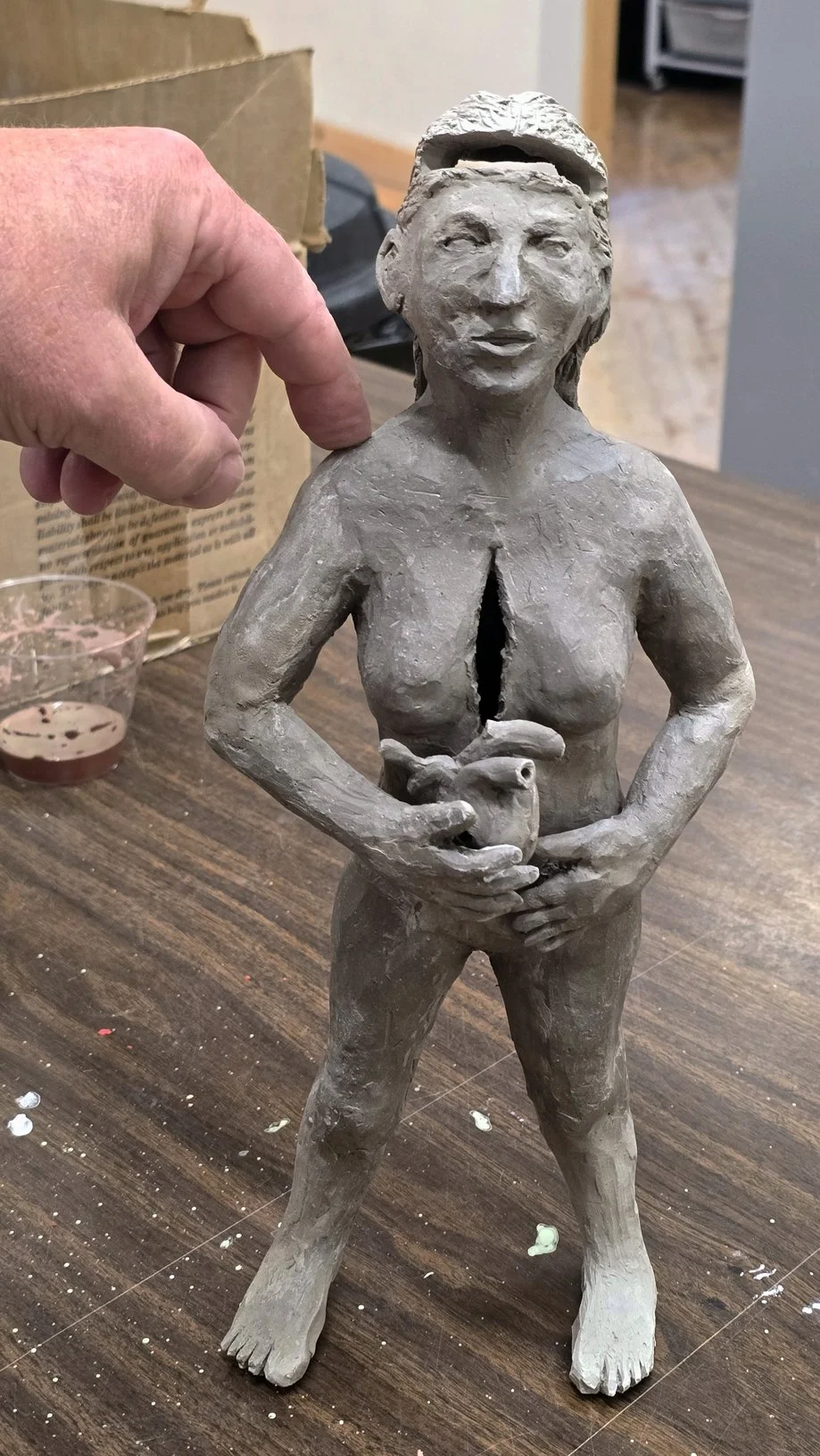
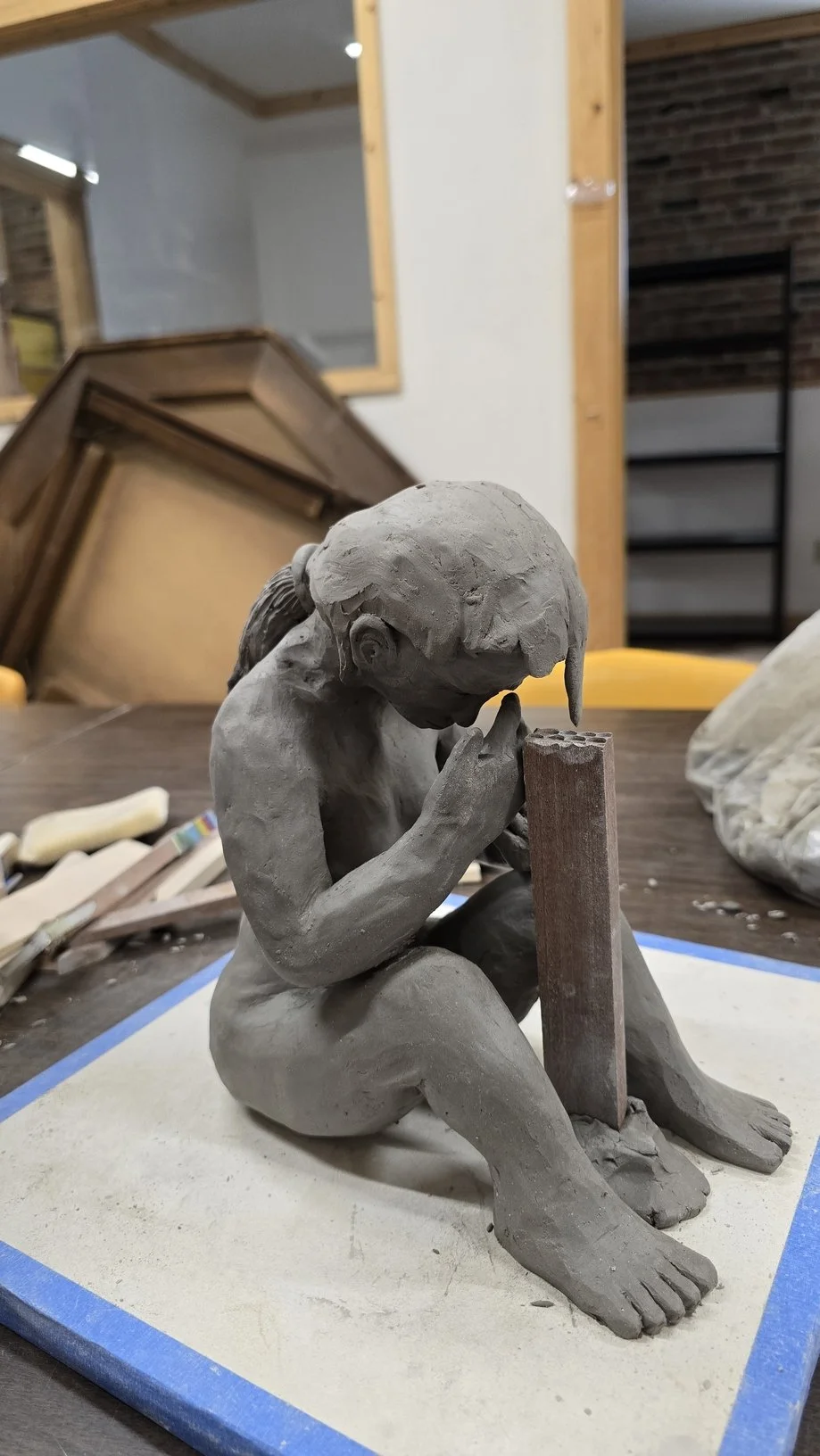
And then, one I’ve been working on for a while. Since I didn’t want this to look too finished, it’s more or less done - I basically just need to keep checking for cracks as it dries and awaits bisque firing. I’m going to use that “Palladium” glaze again, with red for the heart and the um, chest wound. My original thought was that this should be titled something like “the offering” - to grossly oversimplify, offering up her heart and dispensing with her brain in the process. But the more I think about it, the more I realize that the title will dictate the interpretation, and I want to convey some complexity of emotion… it needs to be mounted to some sort of base, and that offers another opportunity to incorporate some iconography that may help add nuance. Anyway, for now, here it is in partially dried mud form… Before mounting on a base, it has to be held upright, thus the finger.
6/24/2026: Notified today that one of my paintings from Tenmile Creek Park, “the Survivor”, was accepted into a National juried show, the Montana Watercolor Society’s “Watermedia 2026” at the Glacier Art Museum. (“The Survivor” is on this website under the landscapes: Tenmile Creek Park page.) I only entered two paintings, and one will be shown, so that’s a 50% acceptance rate… not bad for a national show. If we count the Holter’s Seek the Sun exhibit, I’m 2 for 3… : )
Acrylic is my least preferred painting medium, yet I do a fair bit of painting in acrylics (my preferences in order: oil, watercolor, gauche, acrylic). Some of the plusses of acrylics are insurmountable: cheaper than oils, but a somewhat oil-painting-like look; doesn’t give off the fumes of oils and therefore can be used where ventilation isn’t the best; dries very quickly, allowing a work to be finished in less time (and allowing over-painting of mistakes without having to wait for hours or days)… so yep, I do a fair bit of painting in acrylics. Since I just recently did a bit of teaching painting with this medium, I thought it might be amusing to read what I’ve called my ‘top ten’ things to know about acrylic painting. I used this as a handout for the ‘Courage to Create’ sessions at the Holter - Enjoy!
6/29/2026: just got back from the Waterworks Art Museum’s “Montana Artrepreneurs” exhibit opening reception…. Driving to Miles City from Helena reminded me of just how big Montana is: if you placed the northwest corner of Montana over Chicago, the southeast corner would be in Chesapeake Bay. We enjoyed the opening reception immensely and got to meet a lot of interesting people and see a lot of really interesting artwork. Some of the people represented: Licia Lucas Pfadt, Jean Mazur, Afton Ray, Dianne Hausmann, Cheri Dyk, Pat Olding, and Meghan Hanson. I had the good fortune to work with many of these folks while doing the ‘classroom’ portion of the Montana Arts Council’s Artrepreneur program (which has now been replaced by “Art Works”).
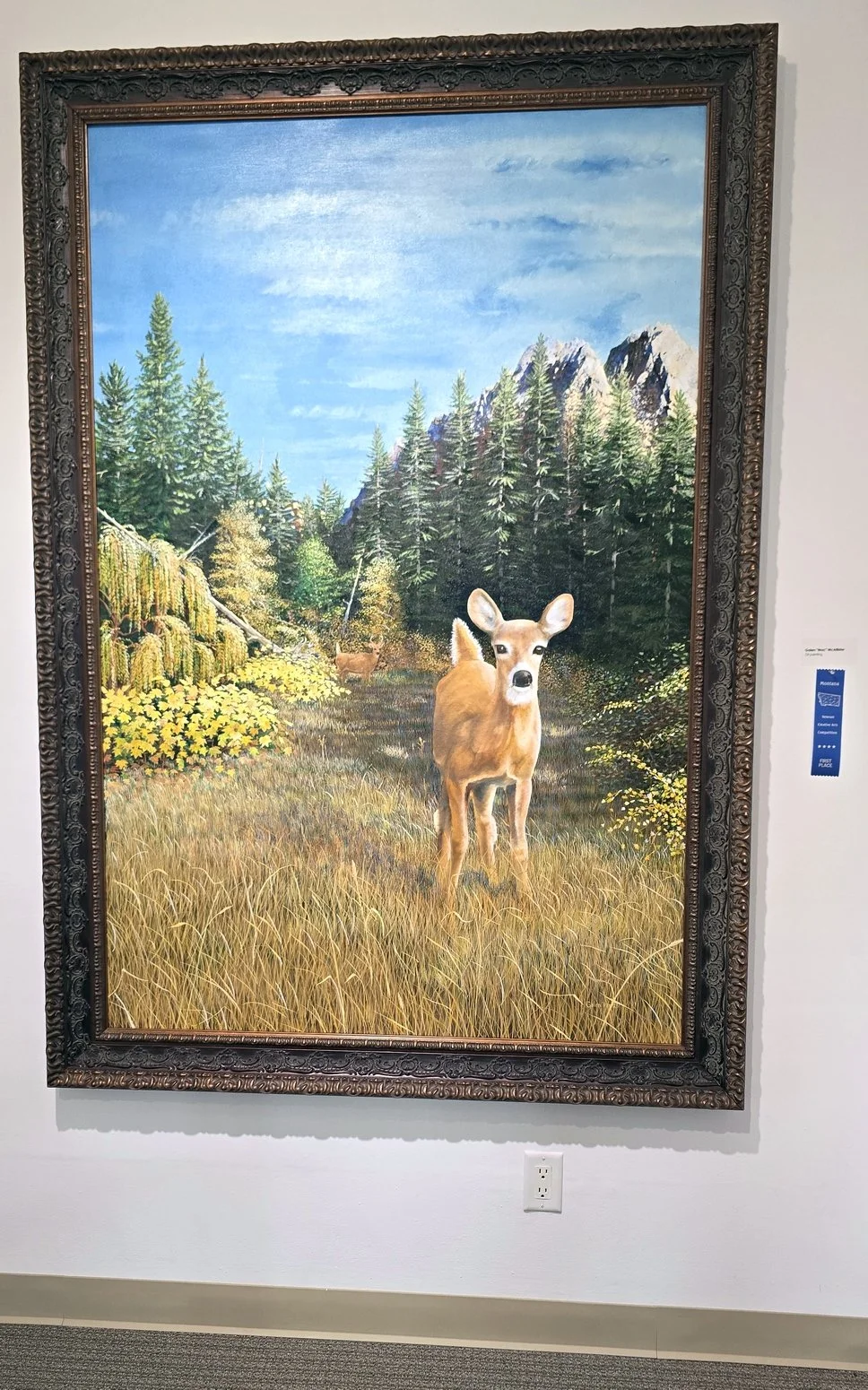
My oil-on-canvas painting “What the Sweetgrass Remembers - an Allegory of Fall[ing]” (or “Rita” - A Fantasy of Whitetails and Unrequited Love) enjoyed pride of place as the first painting visible as you enter the gallery (see below). I have a dozen pieces in this exhibit in total; I’m very lucky to have been selected as one of the ten artists on display.
Here I am posing in front of “Rita”; thanks to Bonny Beth Luhman for the flattering photo. Bonny Beth, thanks for making my pot-gut look a bit slimmer than it really is!
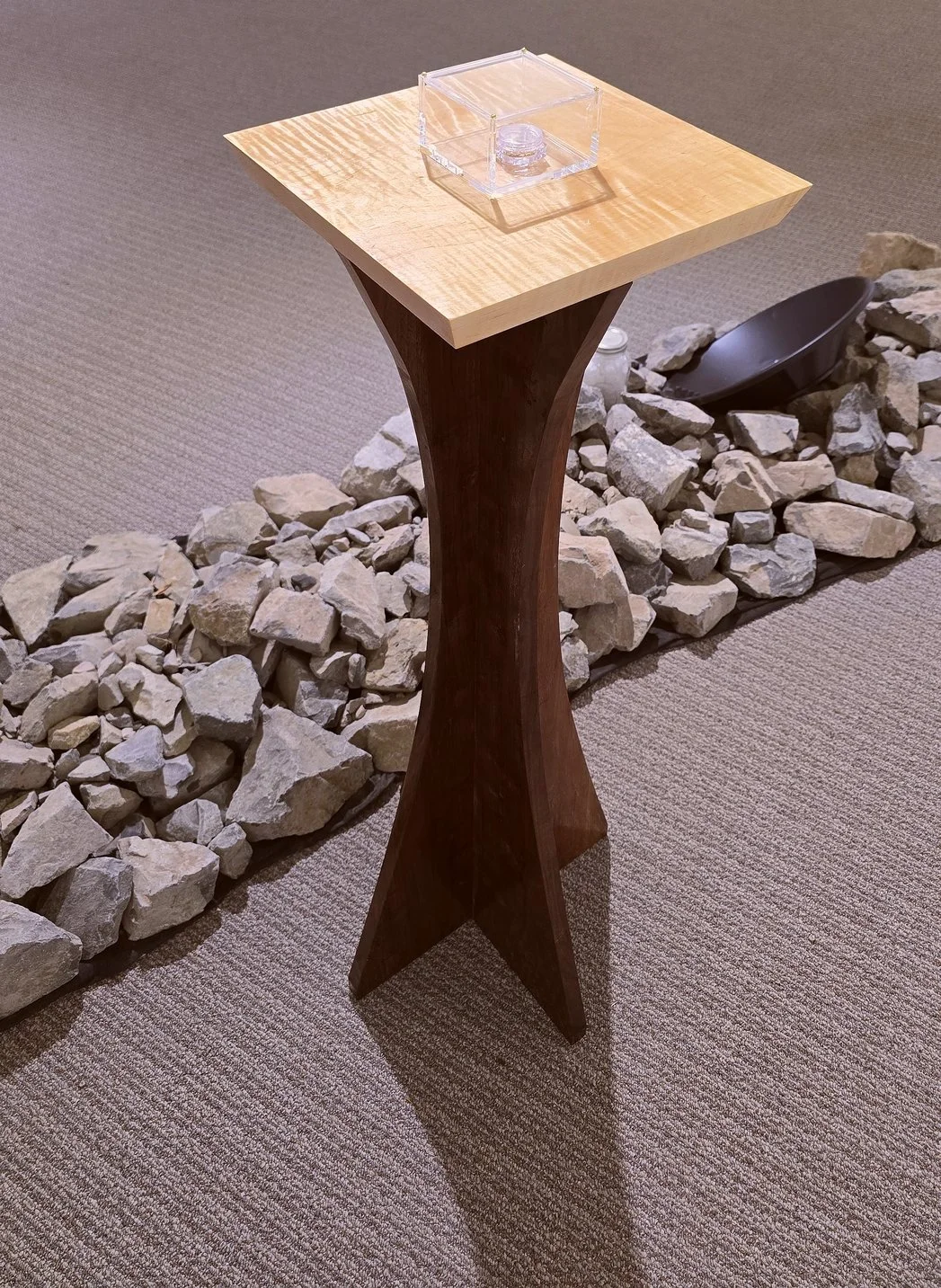
7/18/2026: For the last couple of weeks, I’ve been working on a trio of wooden stands for an upcoming exhibit at the Holter Museum of Art titled “Seek the Sun”. This will be a Group Show featuring works inspired by a painting titled “Golden Sunlight” by Nolan Salix, depicting the terraced walls of the Golden Sunlight open pit mine (near Whitehall, Montana). The exhibit is meant to highlight both the beauty and the destruction of the Western United States’ landscape. My part will consist of a metric tonne of rock arranged in a trail which leads to an approximately 1.8 gram “bb” of gold - along with some explanatory signs (The Golden Sunlight had to process that much rock to obtain that small amount of gold - yet it was still profitable). The stands I’m making will hold the ‘bb’ of gold and the signs, pointing out both the environmental destruction caused by unregulated mining in Montana as well as the fact that the 'clean energy transition’ vital to keeping our planet habitable is utterly reliant upon mining.
One of the stands is made from crudely rough-sawn black walnut boards I purchased sometime in the 1980s along with a top platform of ‘fiddleback’ maple… it’s amazing how much work it took to resaw, plane, cut, sand, assemble and finish it. For the other two, I purchased S4S lumber from Lowe’s, which made them much easier.
I’ve been working in our south-facing driveway (we don’t have a shop), and I’ve had to knock off work by around 1 or 2, as it gets way to hot for a geezer like me. This touches upon one of the ironies of the exhibit: mining (especially for fossil fuels) has made our local summer temperatures hotter… yet a transition to clean energy in order to keep our planet habitable requires mining. Anyway, I’ll get pictures up soon…
8/10/2026: Well…. a good blogger posts an update every day. But I guess I’m not that good at blogging… Once again, it’s been busy, although a lot of that has more to do with deferred house maintenance than with making art. Still, I’ve managed to do a bit of work on a few things. First up: on 8/4/2026, I installed my ‘installation’ at the Holter Museum’s “Seek the Sun” exhibit (Pics below). Eventually I’ll take my good camera into the Holter so that you can actually read the signs, but meantime, here’s a couple of cell phone shots of the installation. I had to place everything on the fourth because it was the only day between exhibits that I wasn’t fully committed to other things… which means that all the other artists’ pieces weren’t installed when I took these pics. Since I had a recent health issue, I broke down and purchased rock from a landscaping company and hired a couple of guys from “Strong Backs 4 U” to help move the rocks; my original plan was to pick and place my own rock using only my aching back. I also had to use gold dust instead of a gold nugget; nobody local had a 1.8 gram nugget available. In a way, that just made it more accurate - the rock is from the same general area as the Golden Sunlight, and the gold in the Golden Sunlight’s ore was primarily in the form of nearly microscopic flakes embedded in the rock.
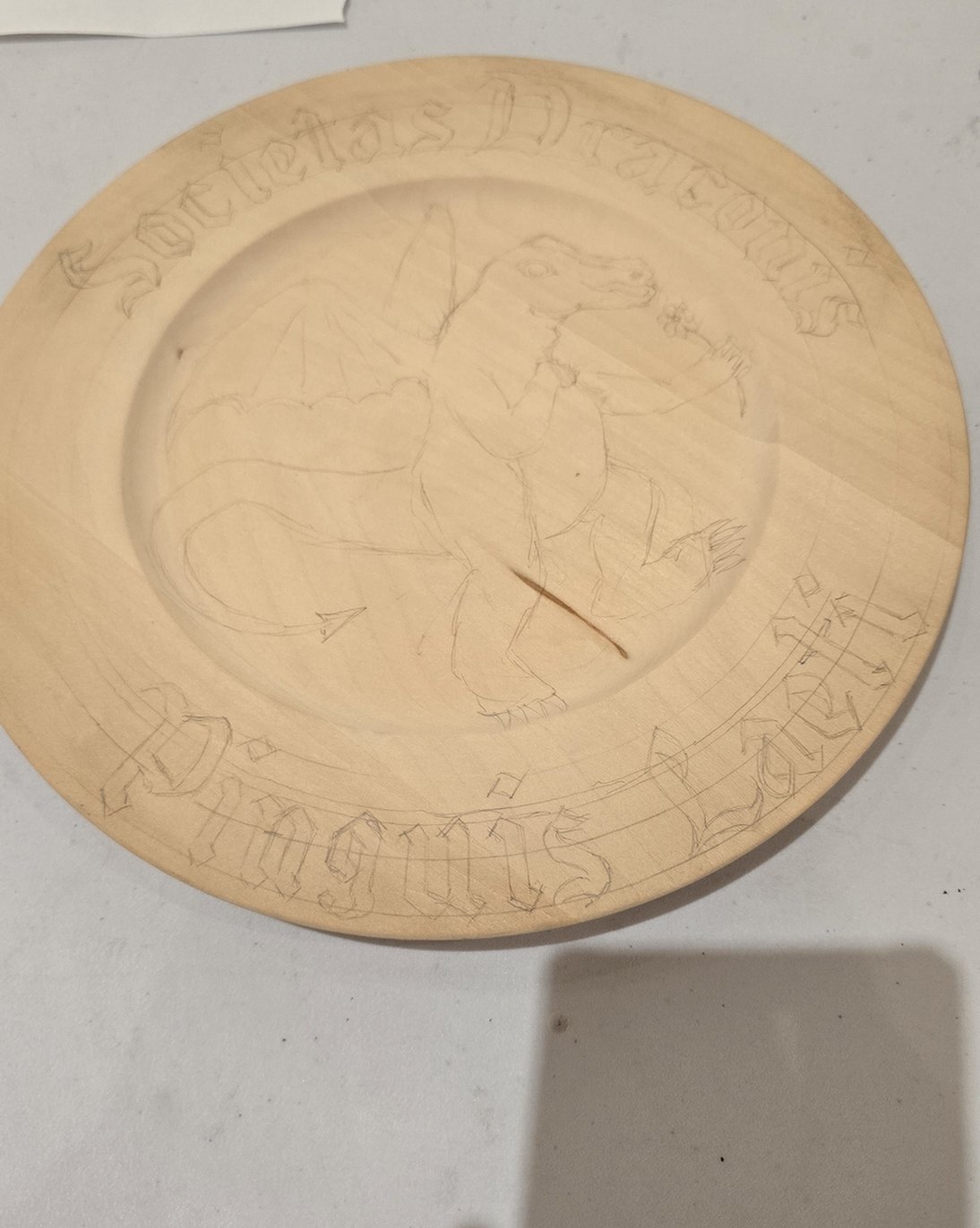
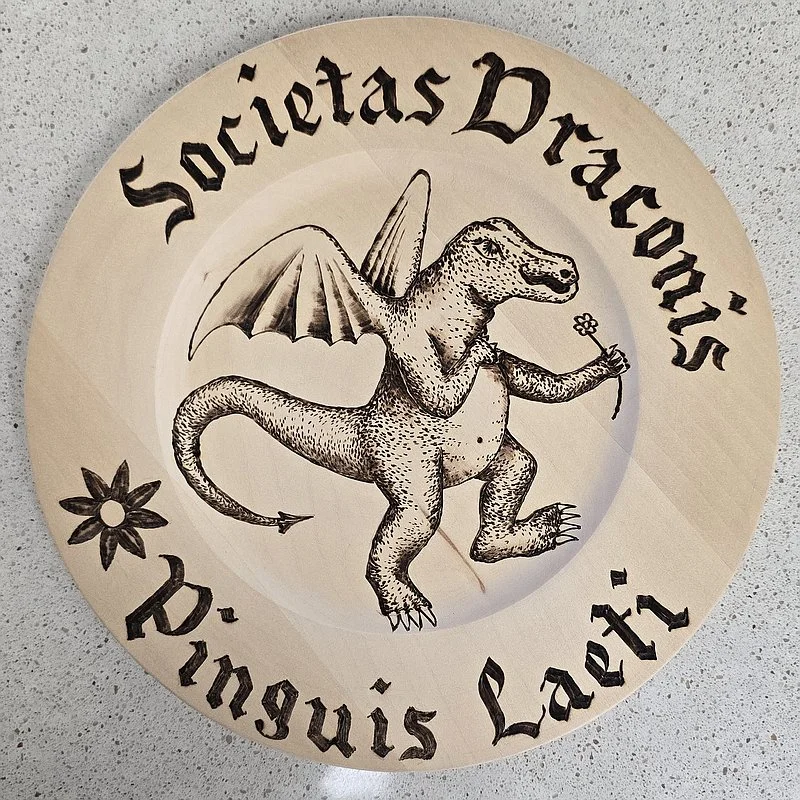
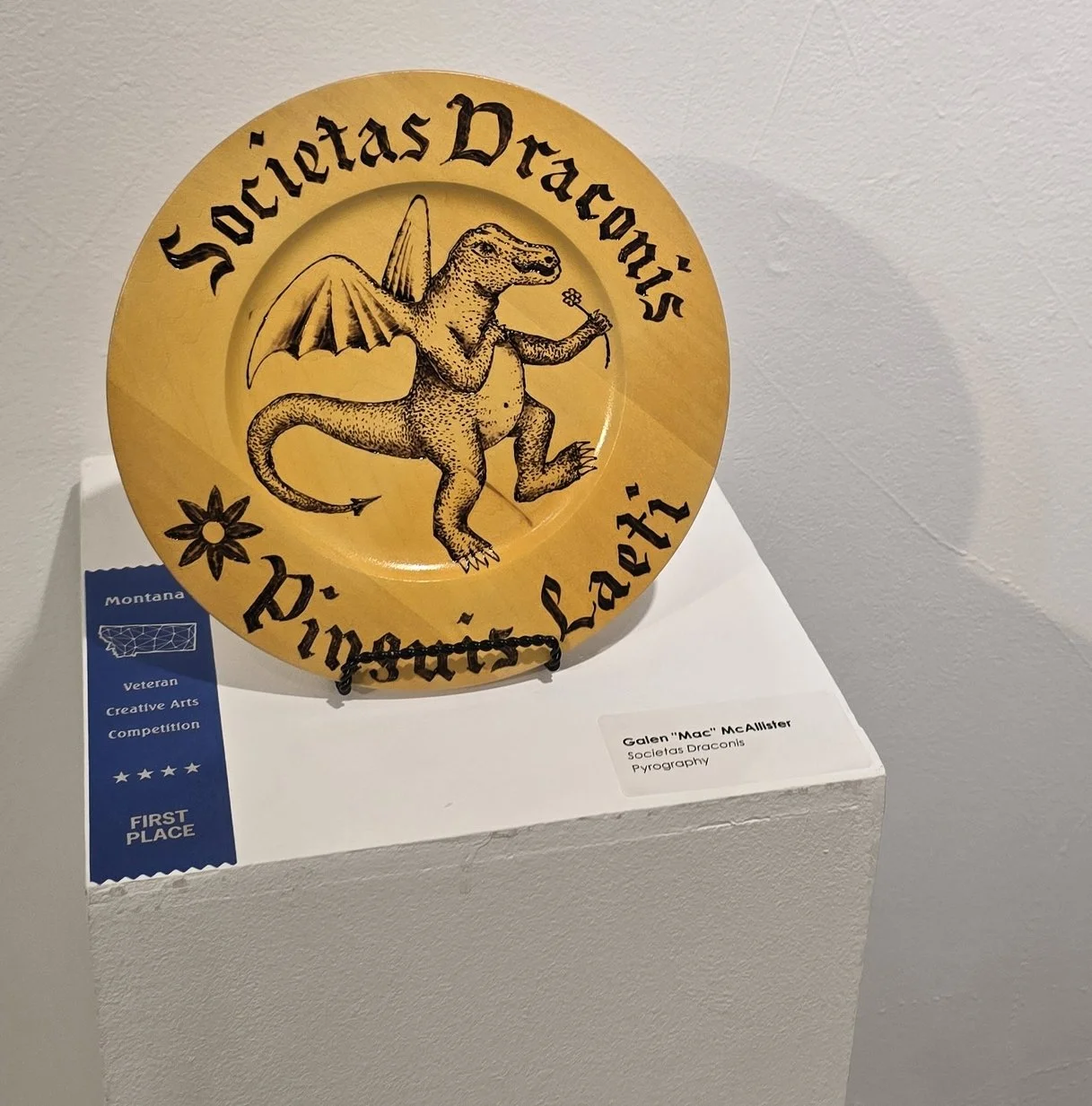
Meanwhile, while I’ve been making the stands, signs, etc. for the “Seek the Sun” exhibit, I’ve been spending time with the veteran’s group (“Courage to Create”) at the Holter Tuesday mornings (Tuesdays 10:-12: - if you’re a veteran in the area, c’mon by!). Our latest thing is pyrography, otherwise known as woodburning. A couple of Tuesdays ago I did a very small picture of an eagle’s head while we became acquainted with the tools; after that I went for a larger project on a wooden plate. Here’s the idea sketched in with pencil:
The fourth being a Tuesday, the vets group was still meeting for an hour after I finished the ‘installation’ for Seek the Sun. So I sat down and got this far on the woodburning (maybe I can finish next week):
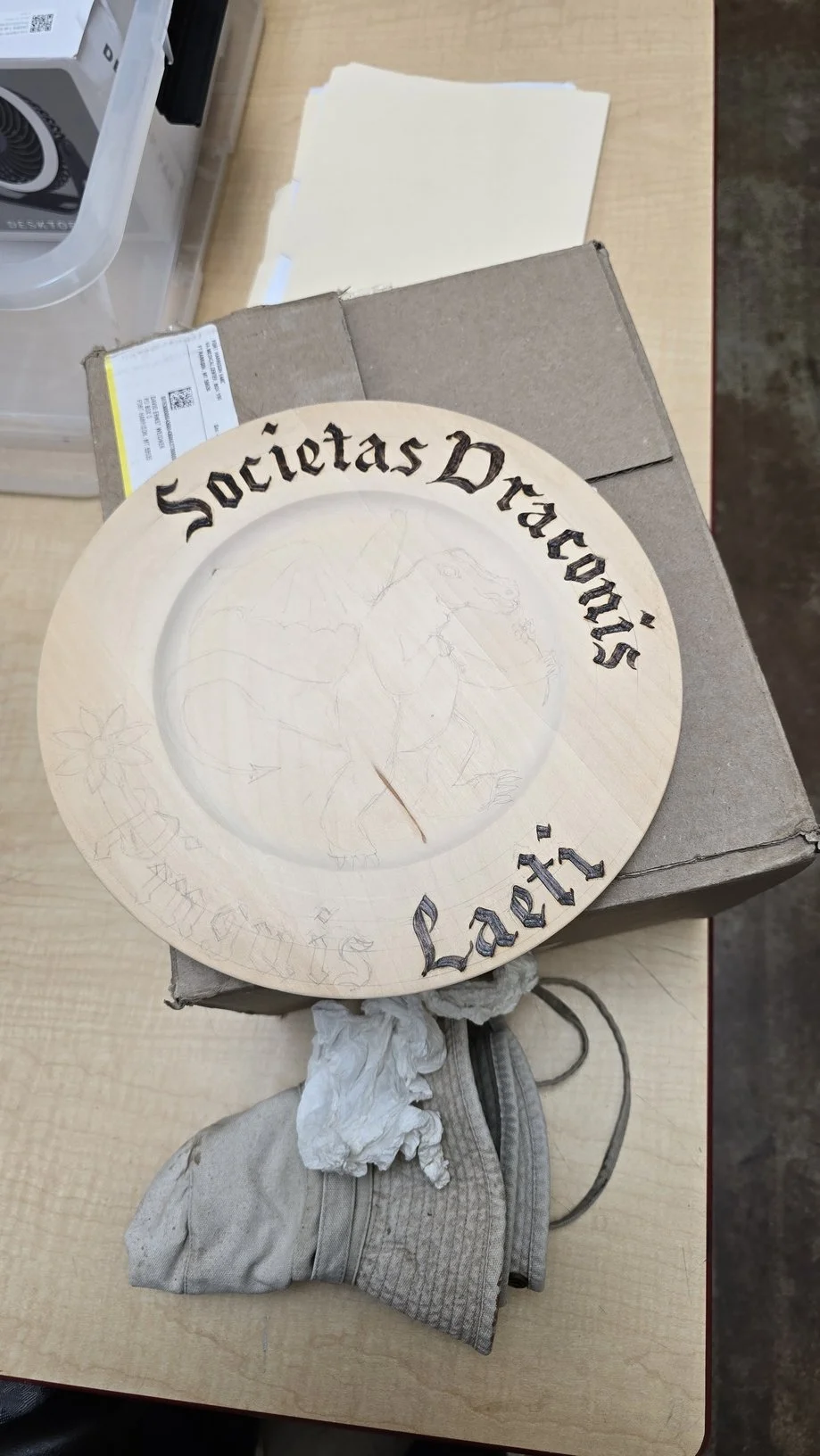
The verbiage is a Google Translate Latin version of “the Fat Happy Dragon Society”!
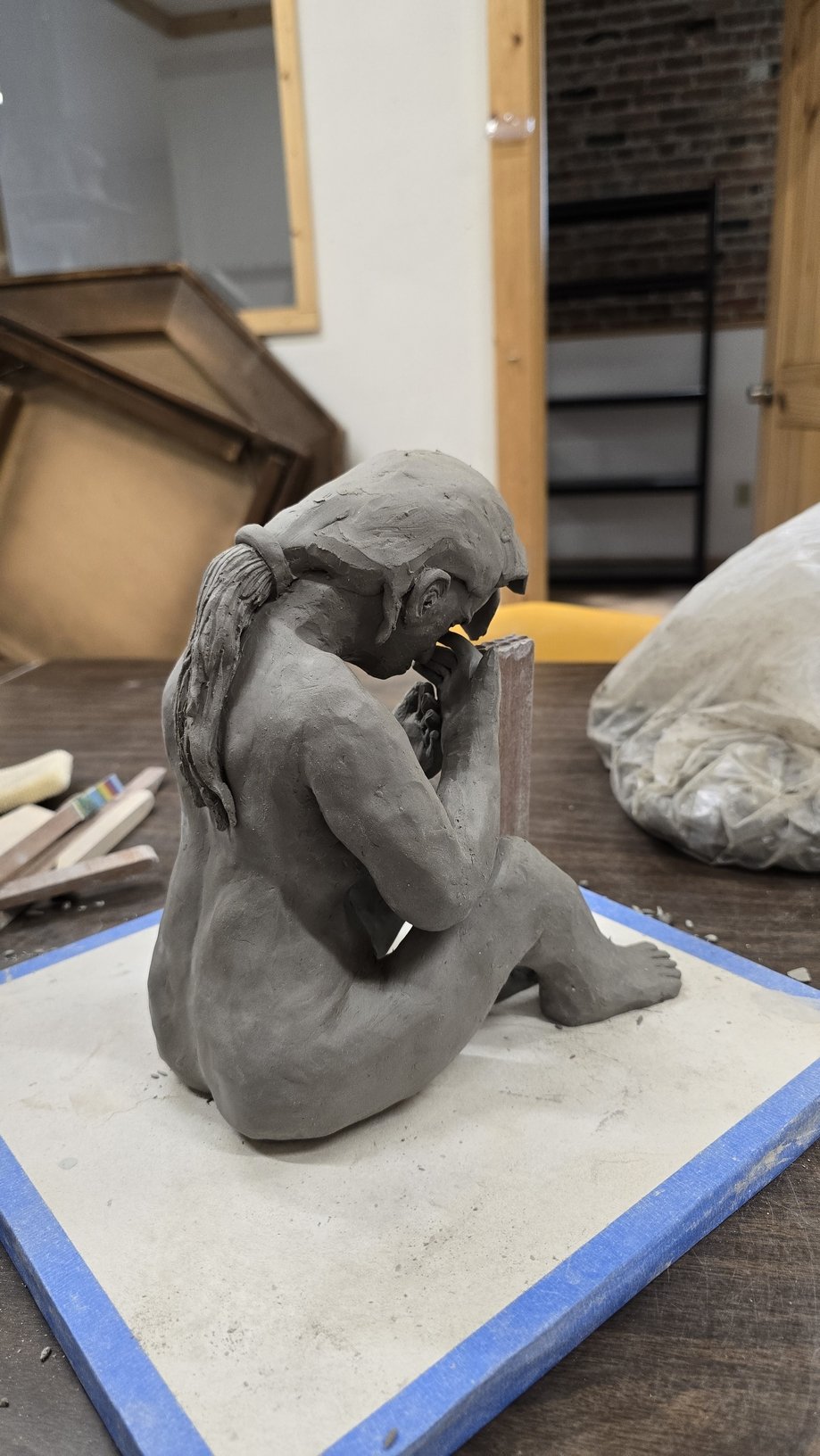
Over the last few Tuesdays (again, if you’re a local vet, stop by Omerta Arts Tuesdays from 1: to 3:!) I’ve also been working on another clay sculpture… this one of a woman who, if I do this right, looks like she’s very sad. Here’s the sculpture as initially blocked out (with an arm yet to be attached):
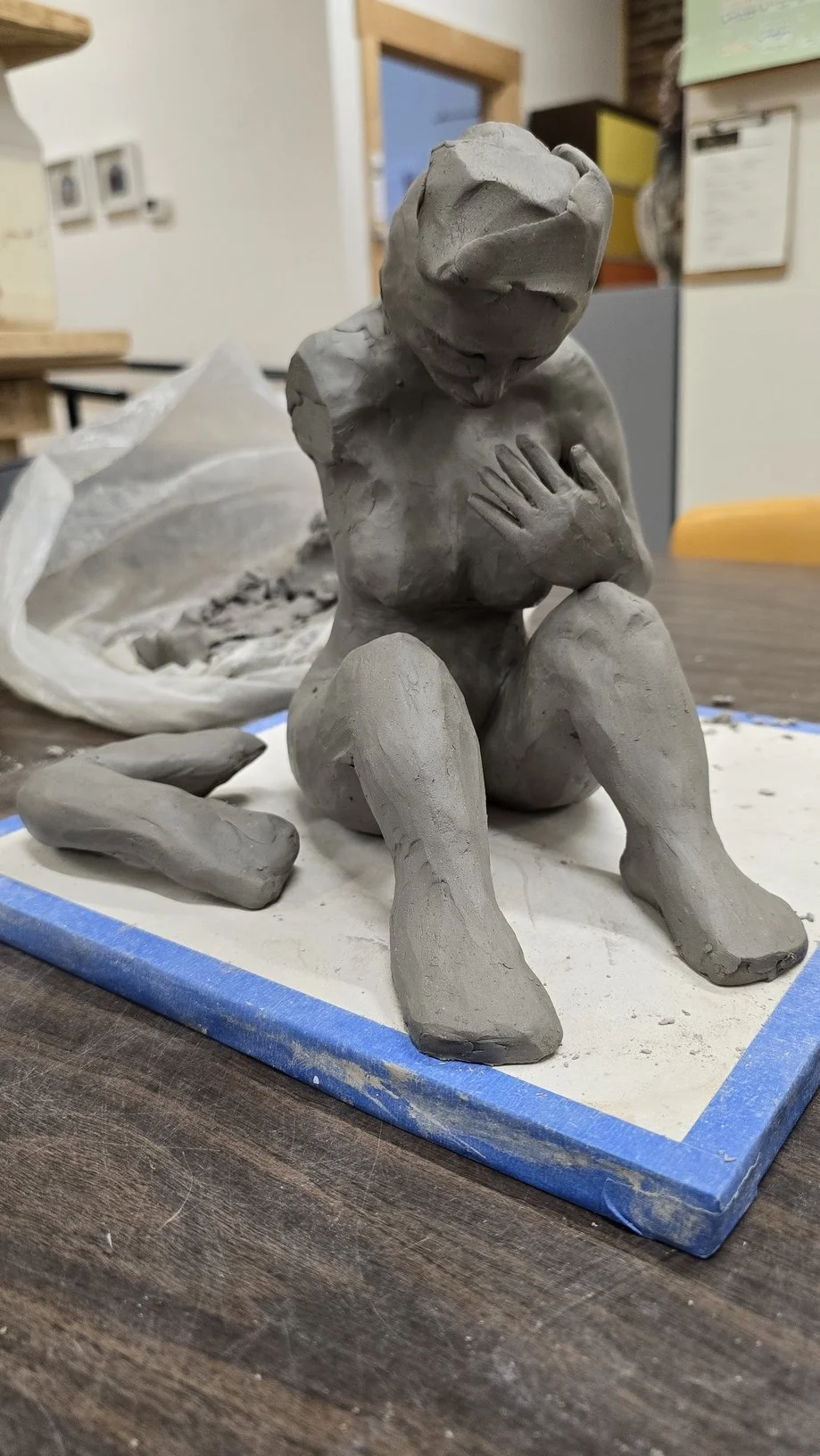
And here are a couple of views fully assembled. Because the clay was wet enough to sag a bit under its own weight, I used a piece of wood to prop up the arms a bit…
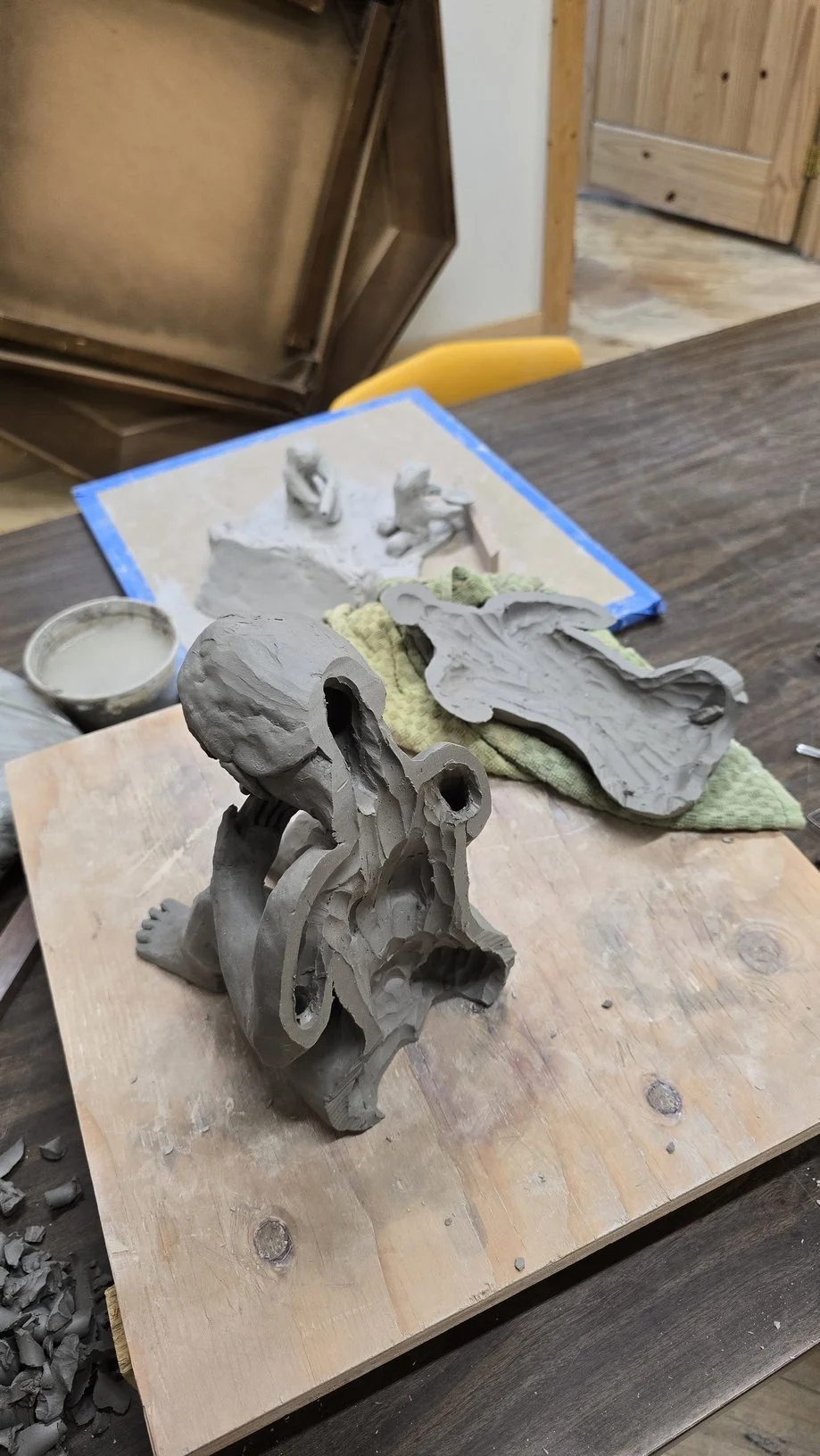
Of course, as regular readers of my blog may remember, a clay sculpture has to be hollowed out so that the clay is not too thick at any one point. Why? Because if you don’t, the moisture in the clay can’t evaporate out, and when the piece heats up enough in the kiln, that moisture becomes steam… which results in your piece blowing up in the kiln. This isn’t just bad because you lose your piece; it may also destroy several adjacent pieces, resulting in some rather upset fellow artists… So here’s the piece being hollowed out. Re-assembly takes a lot of scoring and slip (extremely wet clay, acting as ‘glue’). It also takes a bit of re-shaping, because it’s almost impossible to cut your piece in two, hollow it out, re-assemble it, and not have some distortion.
I should have this piece in final form and drying within a couple of weeks. I’ll post pics (eventually) of that process!
Finally, more from the Fat Happy Dragon Co.: First up - I”ve finished the fat-happy-dragon-on-bicycle drawing I started back in - um, what was it, early June? Anyway, the pic is posted to the Fat Happy Dragon Co. page on this website. To get to the main page / menu, click on the McAllister Art Collective logo at the top of this page…
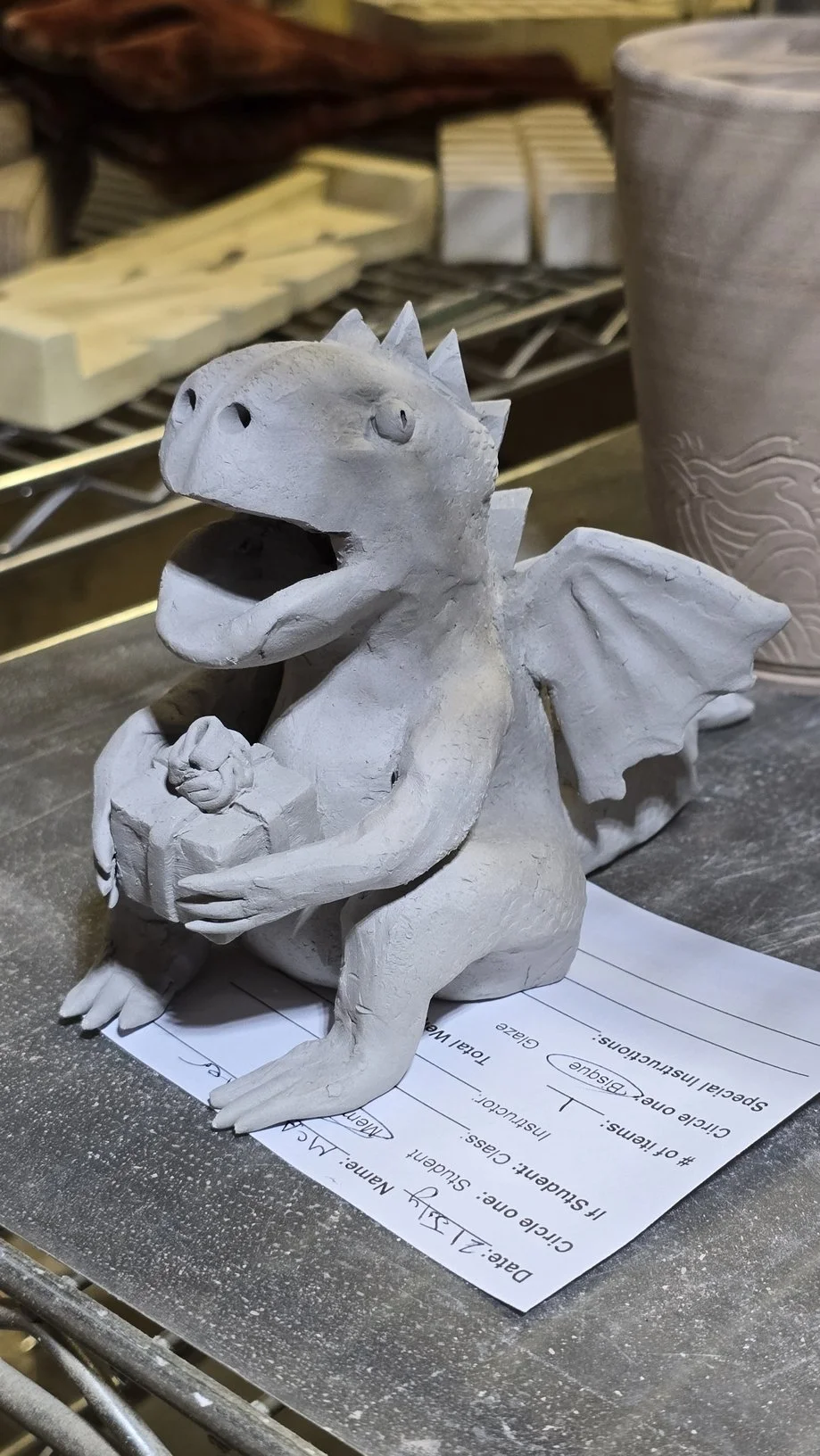
And of course, I’ve done another small ceramic sculpture of a dragon, holding a gift just for you… here it is below before firing, while it’s still “greenware”:
8/11/2026: Blog posts two days in a row!… I finished the woodburning on the ‘pyrography’ dragon plate; all that’s left is to spray some finish on it…
…and while I was at the Holter, I took some photos of the finished ‘Seek the Sun’ exhibit, to include my installation. If you blow up the pictures, you can read the text… but I’ll post the full text below these pics of the exhibit, also. The sign at the north end:
The sign at the south end:
An overall view - the painting which inspired the exhibit, from the Holter’s permanent collection, is on the far wall:
The gold dust is on the middle stand… hopefully, you can see it in the close-up:
Not a lot, is it?…
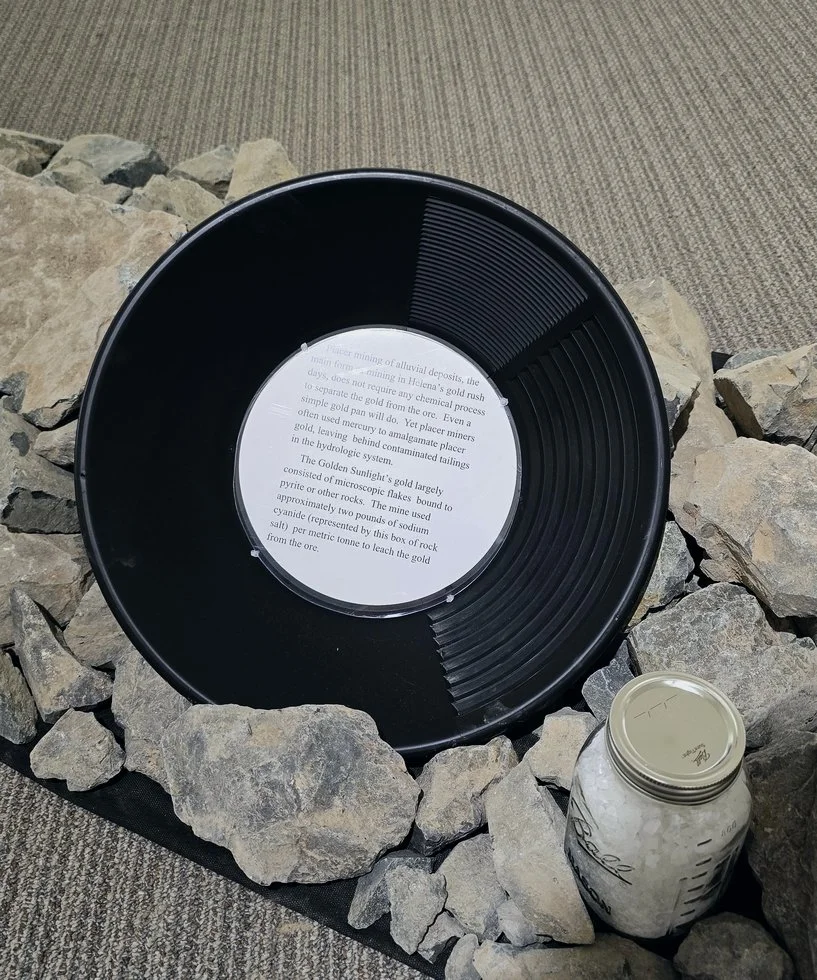
Since I didn’t give the Holter a title for this piece, it’s “Untitled”… and it is definitely mixed media! One curious change made after I installed it: the rock salt (representing cyanide - it didn’t seem wise to use the real thing) is now in a mason jar. I had it in an open cardboard box, and the sign in the gold pan refers to “box” not “mason jar”. Perhaps the staff was worried about someone tripping over it and getting rack salt all over their carpet? Who knows? Since it’s not that significant a deal, I’m not even going to mention it to staff… although if they read this blog…

Text on the sign at the south end: The Golden Sunlight processed the amount of rock you see here to yield 2.4 grams per metric tonne in early operations, diminishing to 1.46 grams/tonne by 2015.
The Golden Sunlight mine exemplifies mining in Montana. In full scale production by 1982, it provided high paying jobs through May of 2019, closed when yield dropped to unprofitability, and is now providing its owner with renewed profit as tailings are re-processed and re-deposited into the pit as part of a clean-up effort .
Milling was by size reduction, then cyanide vat leaching: twelve 400,000-gallon leach tanks, washing and treatment of slime fraction by carbon absorption using carbon-in-pulp tanks and up-flow carbon columns. Gold is removed from the carbon in pressure stripping vessels using a caustic cyanide solution. The sand fraction goes to a sand tailing retreatment using concentration in spiral shaped launders.
While equipment and operational capital (operating expenditures such as fuel, utilities, wages and taxes, i.e., the cost of extraction - typically around 70% of gross revenue for most mines) remained heavily concentrated in Montana, Corporate Net Earnings for owners Placer Dome and later Barrick Gold Corporation went to shareholders no matter where located.
Mining operations led to multiple accidental releases of cyanide and other toxins. Cyanide heap- and vat- leach processing was restricted by Montana Initiative 137 in 1998, but existing operations were ‘grandfathered’ allowing them to continue.
Mine reclamation was not required prior to the Federal Land Policy Management Act of 1976. Mines now must place a bond to cover the anticipated costs of clean-up. For mines abandoned prior to 1976 and for which no responsible party still exists, the Montana Department of Environmental Quality runs an Abandoned Mine Lands program; the funding comes in part from coal severance taxes, but also in part from Federal funds, to include the Infrastructure Investment and Jobs Act (public law 117-58 (Title VII, Sections 40701-40704) i.e, from taxpayer funds.
Text of the sign on the north end:
A habitable planet for our children is simply not possible without ‘clean energy’. 'Clean energy' is not possible without mining. Nearly every component of an EV starts in a mine, from the steel of the chassis to the lithium in its batteries. Wind turbines require copper windings; high tension powerlines are primarily aluminum obtained by mining bauxite. Today’s more efficient electric motors require copper windings, steel casings, and rare-earth metals for their high-performance magnets. Solar cells require mining silver, aluminum, copper, silicon, boron, phosphorus, and rare earth metals. Gold has more uses than just jewelry; it's critical for electronics, manufacturing, and more. A habitable planet requires that we mine – and also that we regulate mining to reduce environmental hazards.
Barrick Gold deserves credit; as the owner of the Golden Sunlight, and in cooperation with Reclaim LLC, the mine is currently reprocessing tailings from the Golden Sunlight as well as other mines to recover minerals which were not extracted by the technology used at the time the mines were active. It's an innovative approach to a mine's 'end of life'. Sulfides in the tailings are extracted to minimize acid surface runoff and groundwater (so that the acid will not leach arsenic, mercury and other metals from rock into the water). Extracted sulfur is sold to other entities; reprocessed tailings are being deposited in the old pit.
The Golden Sunlight Mine ultimately serves as a reminder that modern mining success should be measured not only by ounces of gold produced, but also by the effectiveness of long-term environmental stewardship once extraction is complete.
Text of the ‘goldpan’ sign:
Placer mining of alluvial deposits, the main form of mining in Helena’s gold rush days, does not require any chemical process to separate the gold from the ore. Even a simple gold pan will do. Yet placer miners often used mercury to amalgamate placer gold, leaving behind contaminated tailings in the hydrologic system.
The Golden Sunlight’s gold largely consisted of microscopic flakes bound to pyrite or other rocks. The mine used approximately two pounds of sodium cyanide (represented by this box of rock salt) per metric tonne to leach the gold from the ore.
As you can see, I attempted to be factually correct and to strike a balance between the ‘pros’ and ‘cons’ of mining.
My personal take: Mining is absolutely essential, and regulation makes the difference between mines which have an overall positive impact on our world and those which are detrimental to our world. Of course, this is only possible in countries which are not corrupt and have well-functioning governments. Alas, too many oligarchs don’t care - they can mine where there is little or no regulation, or where regulations disappear when palms are greased. To them environmental destruction is a “you” problem, not a “me (them)” problem… by the time the chips have fallen, they’ll be dead. In the meantime, they can live very well indeed off the proceeds…
18 Aug. 2026: Spent a fair bit of this afternoon refining the female nude I’ve been working on… here it is (above) as of today. Almost done, I’m thinking, assuming it survives the kiln. I intend to glaze this in the same shiny “palladium” glaze used for a reclining nude I did back in March/April. We’ll see how that turns out…
22 Aug 2026: Got the ‘heart of gold’ sculpture covered in ‘black crhome’ and gold paint, with just some touch-up remaining to do. Meanwhile, I’ve expoxied the ‘Seussian’ sculpture to a suitable base (painted in a flat green, of course), so all that remains for it is to make a “leash” for the dog-like creature. Pic below… I’ve moved a few things into a small shared studio at Omerta Arts, and I should be doing some work in oils there by next week. We still intend to build a studio in an unfinished room in our basement, but for various reasons that plan had to be put on hold. The space in Omerta will give me a chance to create some images which I’ve been meaning to get around to doing for quite some time. I think I’ll start with some florals as “warm-up”… stay tuned!
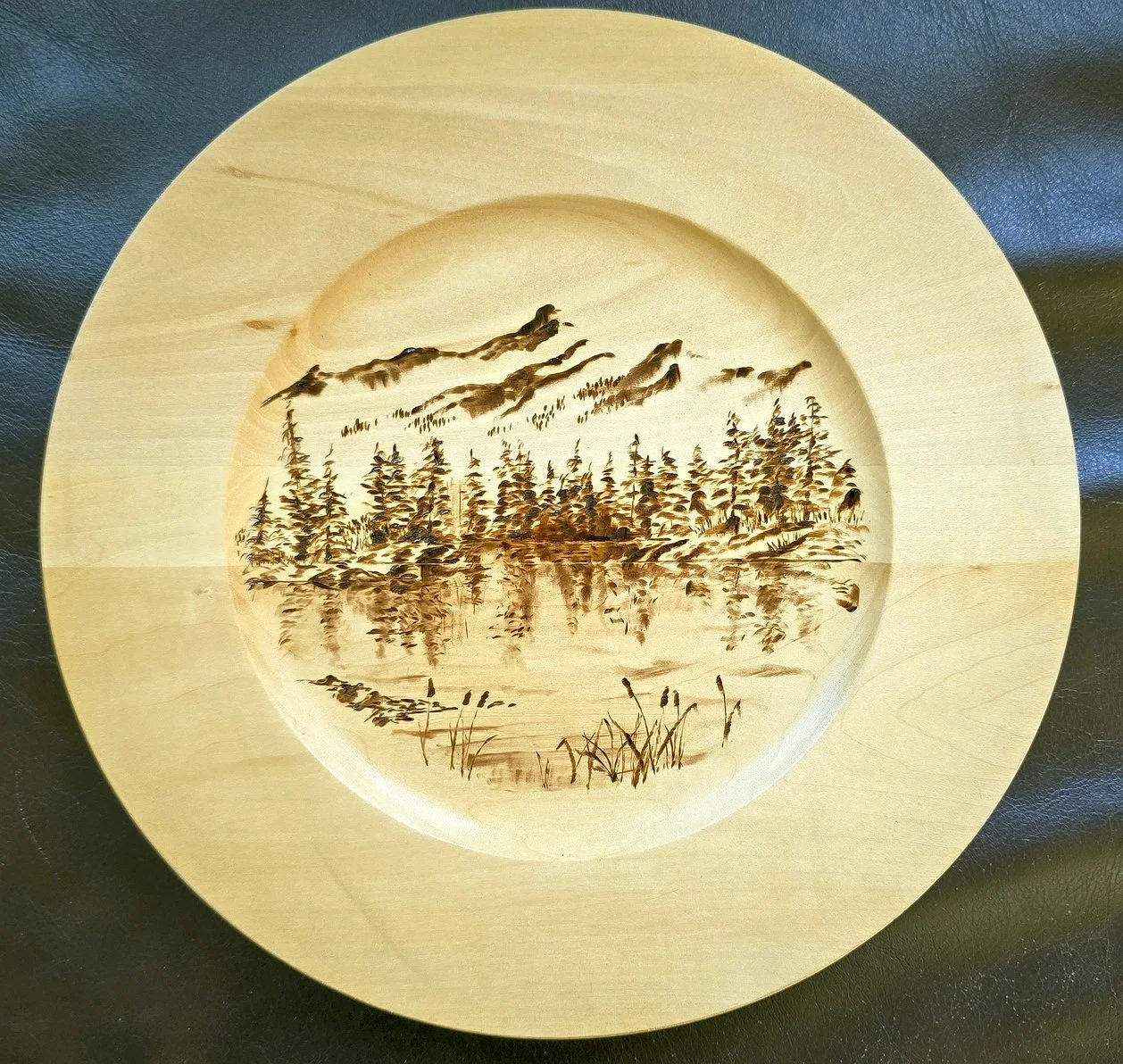
9/2/2026: Our group of veterans meeting at the Holter Museum of Art (10:00-12:00 every Tuesday; vets, care-givers and active duty all welcome) spend several sessions on ‘pyrography’, aka wood-burning. At the last pyrography session, I burned more two wooden plates - the first one, below, is a simple mountain lake scene.
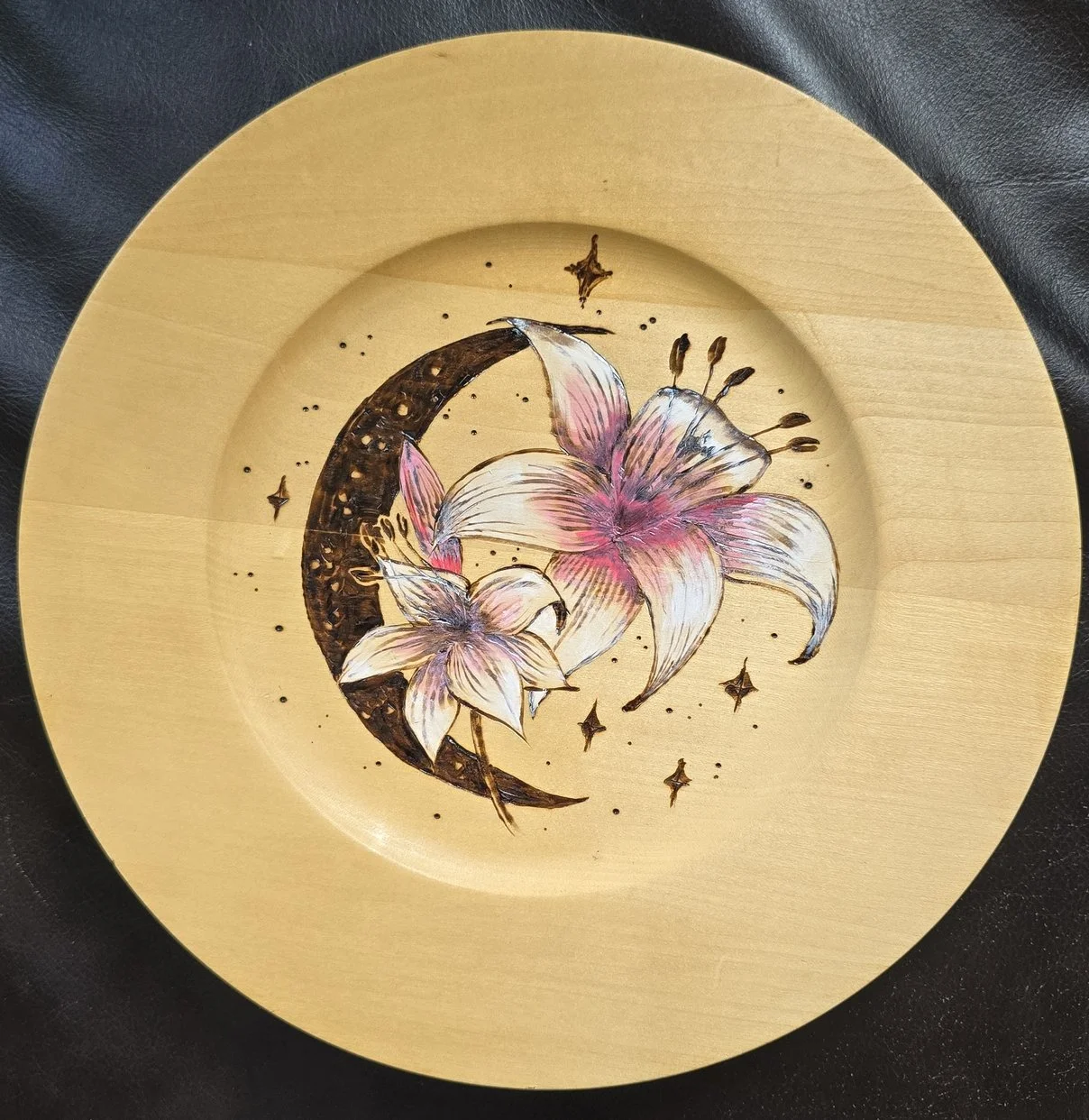
The second used a design from a book of ideas for pyrography. I burned this as a simple black and white, but my sweetie suggested that it would be better with some color… so I added a thin layer of acrylic. She was right; the color makes it pop (below).
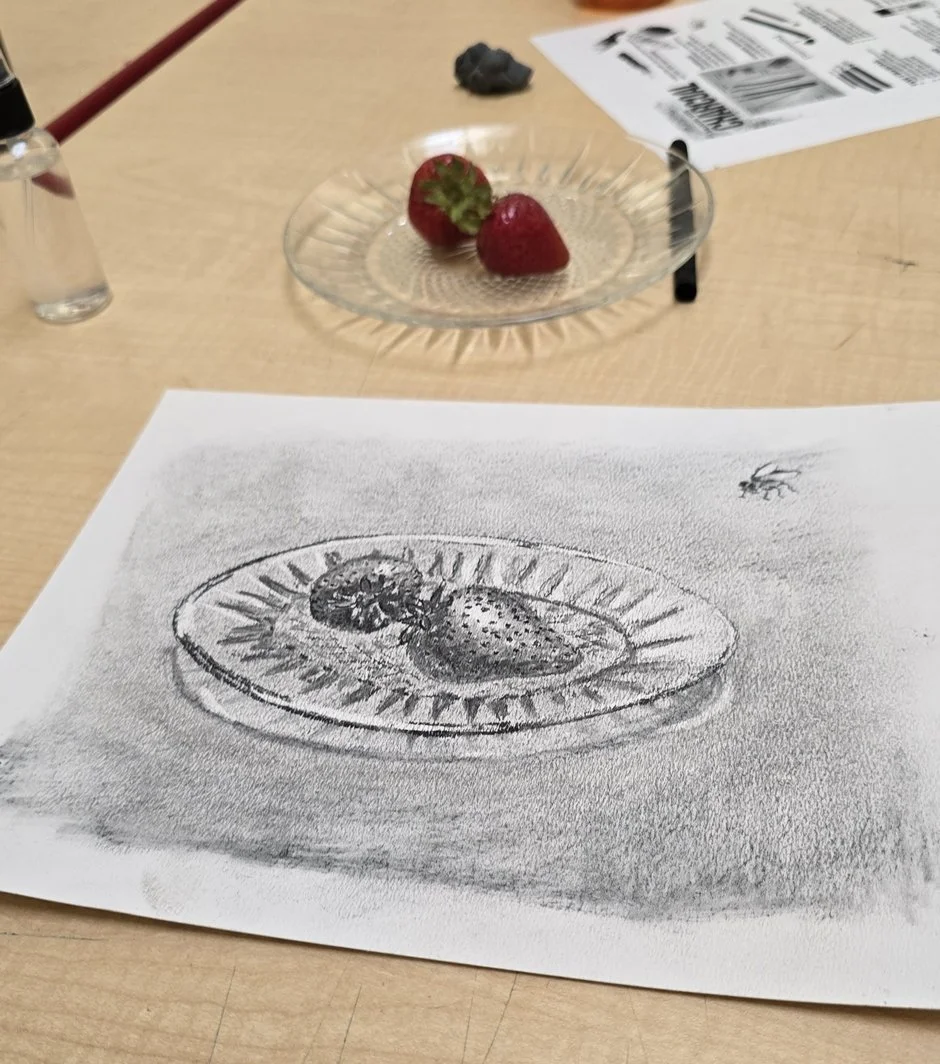
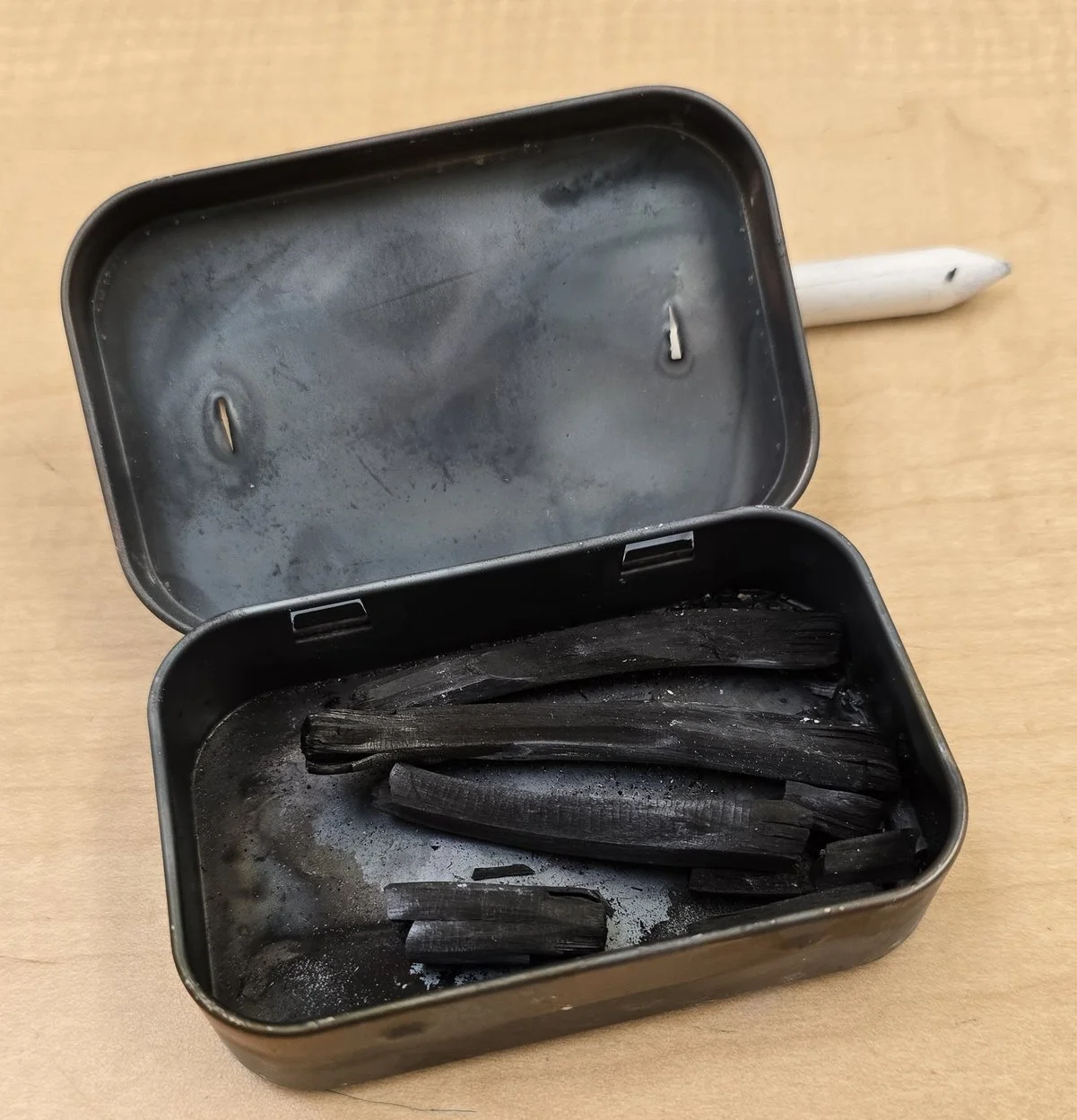
Then yesterday, we made some simple charcoal drawings… and made our own charcoal sticks from willow branches. It’s not too complicated; peel the bark from the twig; place it in a closed tin with a couple of holes to let smoke out; throw it into a wood fire…. Next week we’ll draw with the charcoal sticks we made this week. My charcoal drawing (of strawberries) below; being the wise-acre that I am, I had to add a fly that was buzzing our subject fruits…
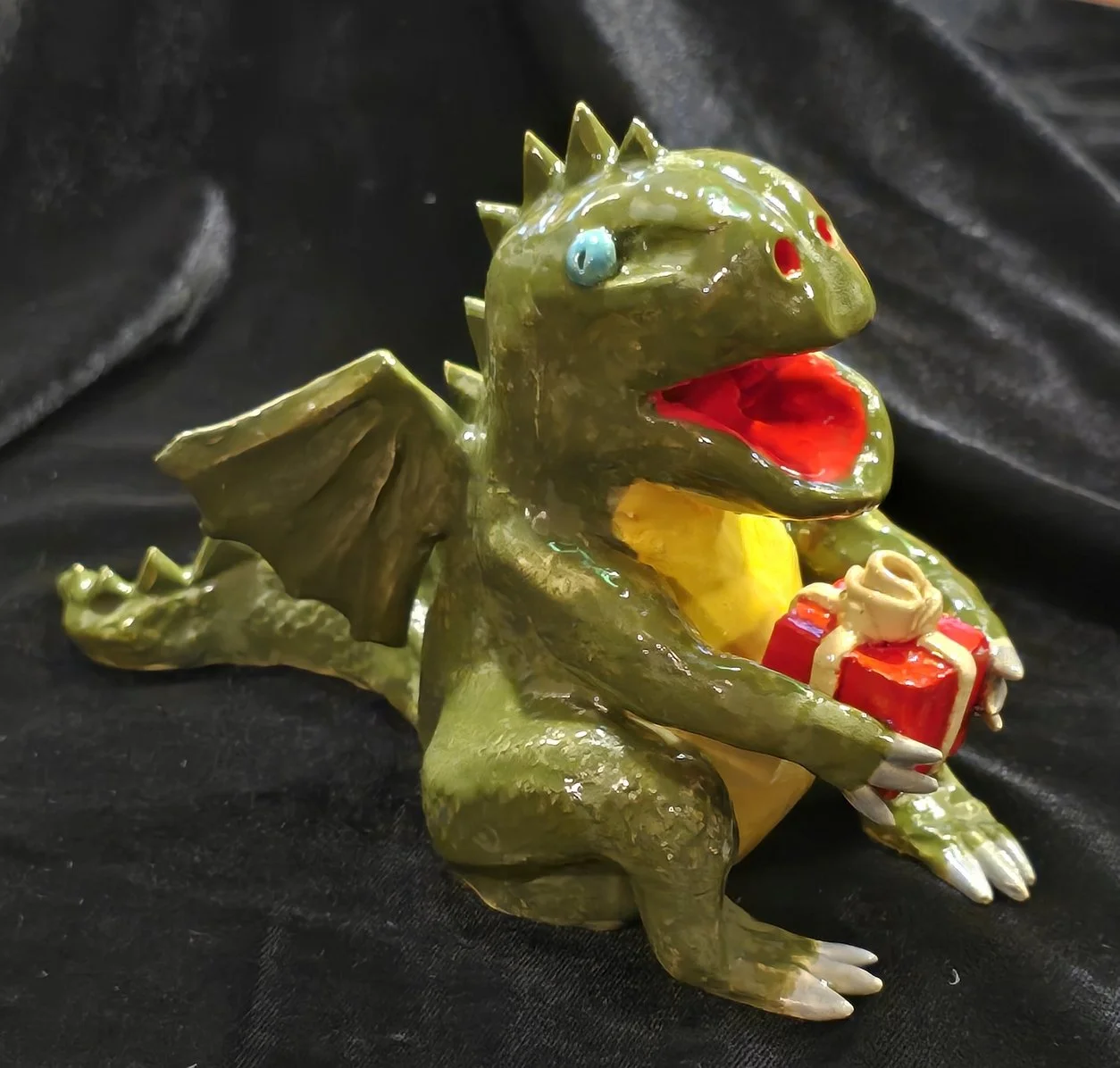
Finally, over at the Omerta Arts Syndicate, my latest small Fat Happy Dragon ceramic sculpture was out of the kiln… he’s so happy to have a present!
9/4/2026: Attended the closing ceremony and awards presentation for the Montana Veterans Creative Arts Festival exhibit / competition at the Holter Museum of Art this afternoon. Since this year the State festival is no longer a qualifier for the National level, I was able to enter an oil painting which was completed just a bit over a year ago; in prior years, artwork more than 12 months old was ineligible… I received first place in oil painting, pastel, and pyrography - ribbon pics below. When I came in, one of the Holter staff asked me “so how does it feel to have pieces in two different shows in our museum at the same time?”. In addition to the Veterans’ show, I have an installation in their “Seek the Sun” exhibit. It hadn’t really registered, but now that she’s mentioned it, well, it feels pretty darned good.
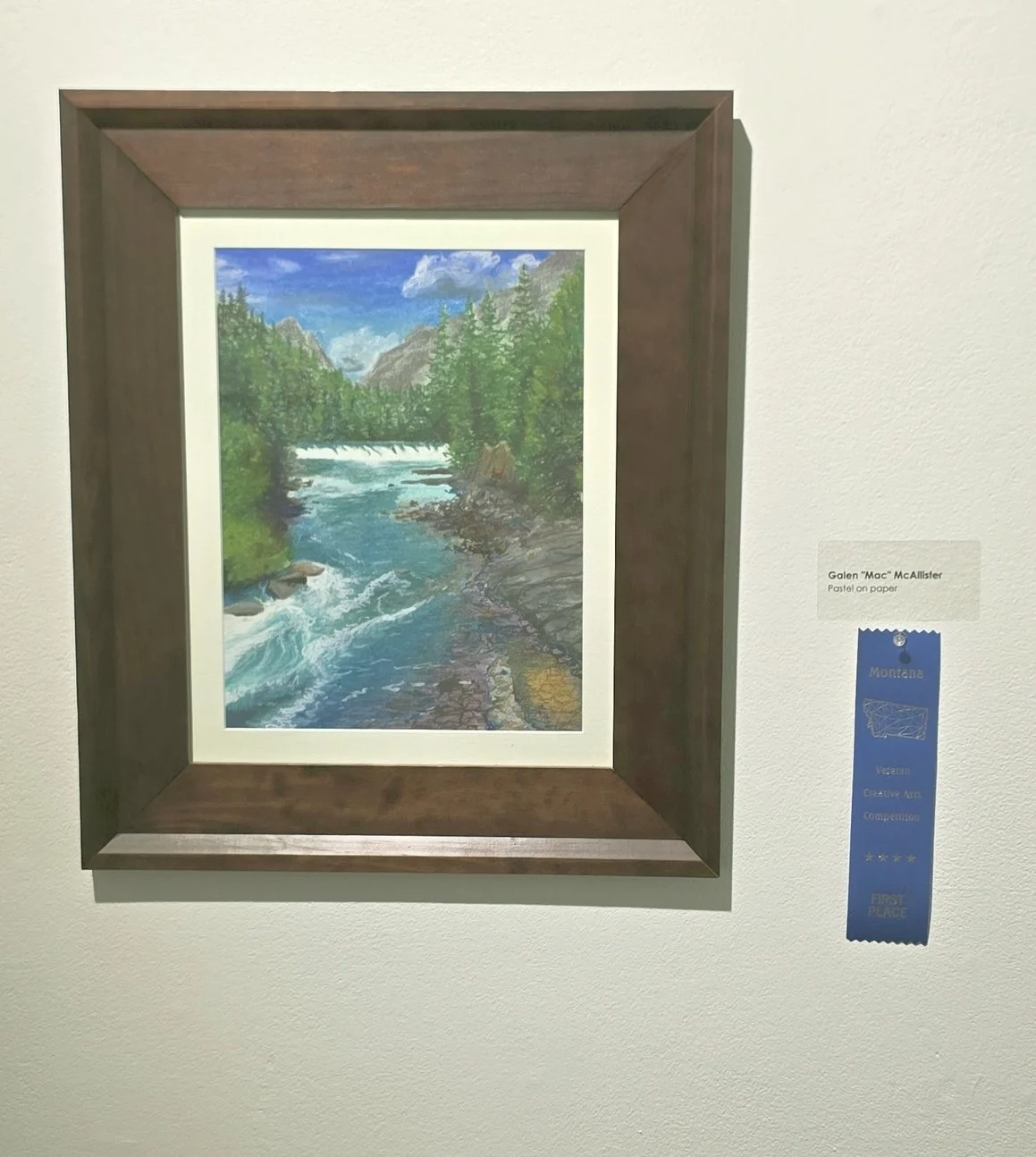
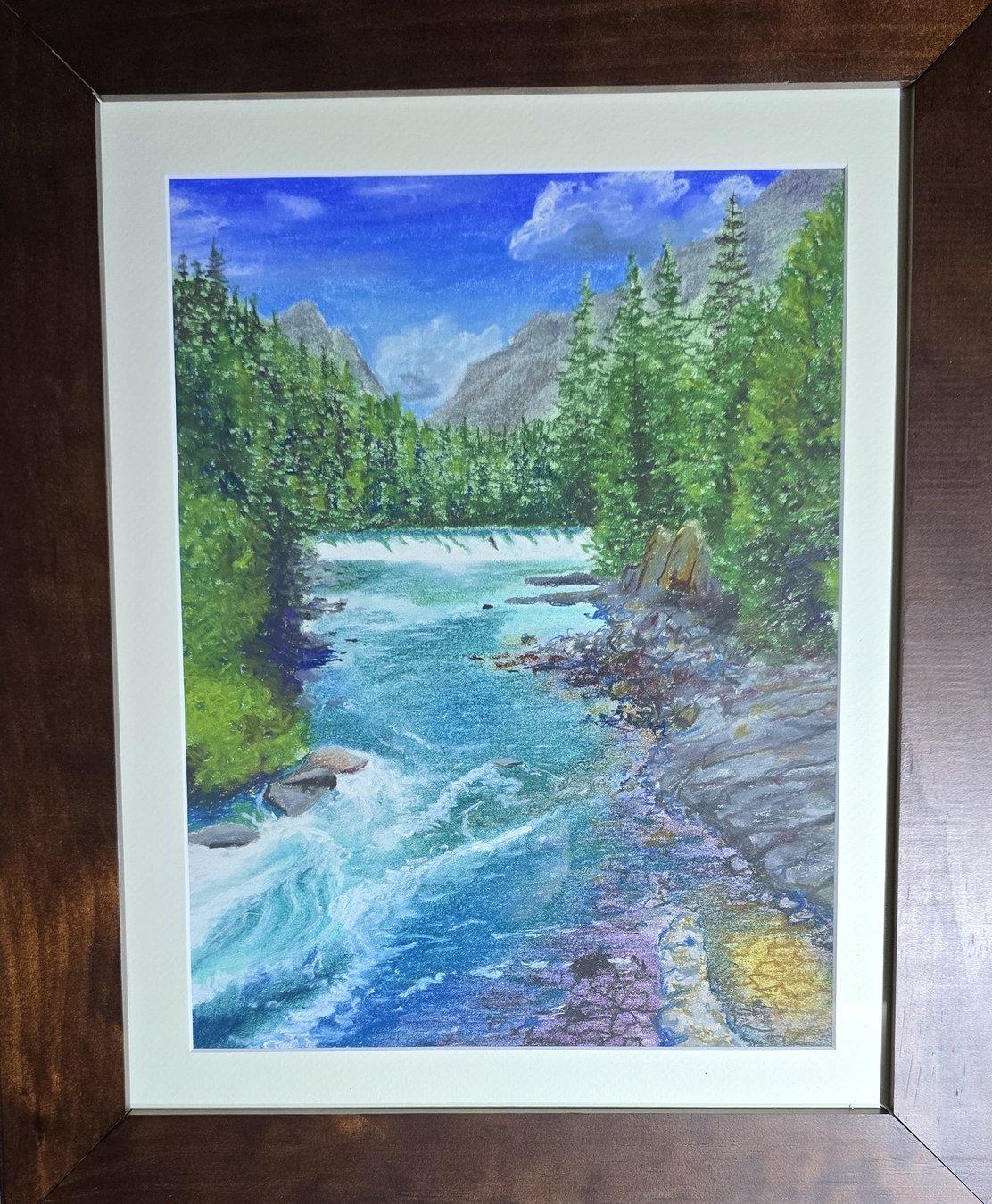
The pastel piece is a sketch of MacDonald Creek in Glacier National Park. It’s going to be a gift, so I’m not putting it on my landscape pages - but you can see it here on my blog! (below)
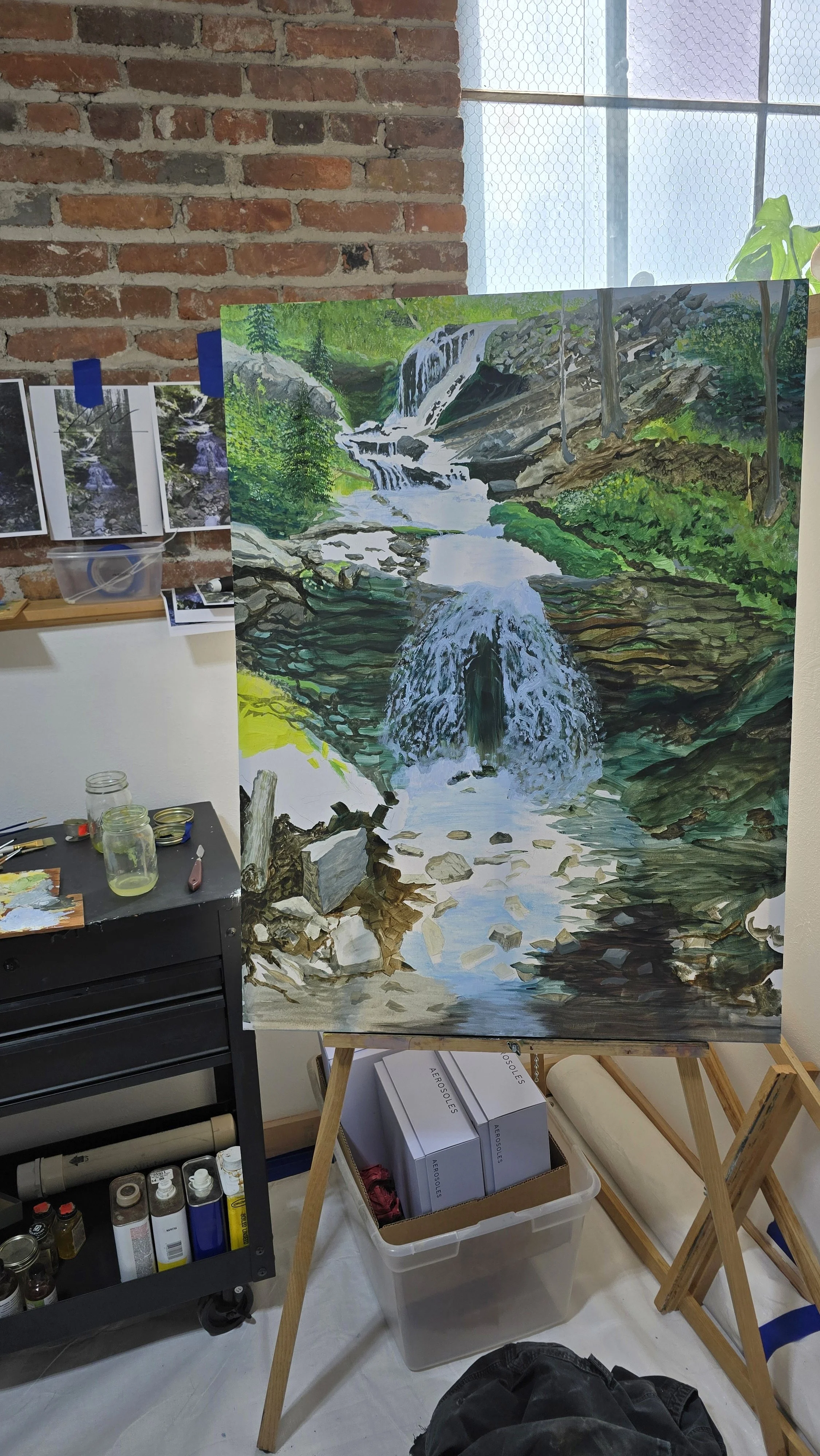
9/6/2026: Spent the afternoon painting in my shared studio space at Omerta Arts. This is an oil painting, which means that often, after blocking in background colors, you have to wait a couple of days to paint in the next bit. I love oil painting, despite the dry time and the fumes. I haven’t had the opportunity to paint in oils since last July. Here’s how the picture looked as a started today. Our goal is to eventually build a studio with separate ventilation in our basement so that I can paint at home, but for now, Omerta Arts is a good solution.
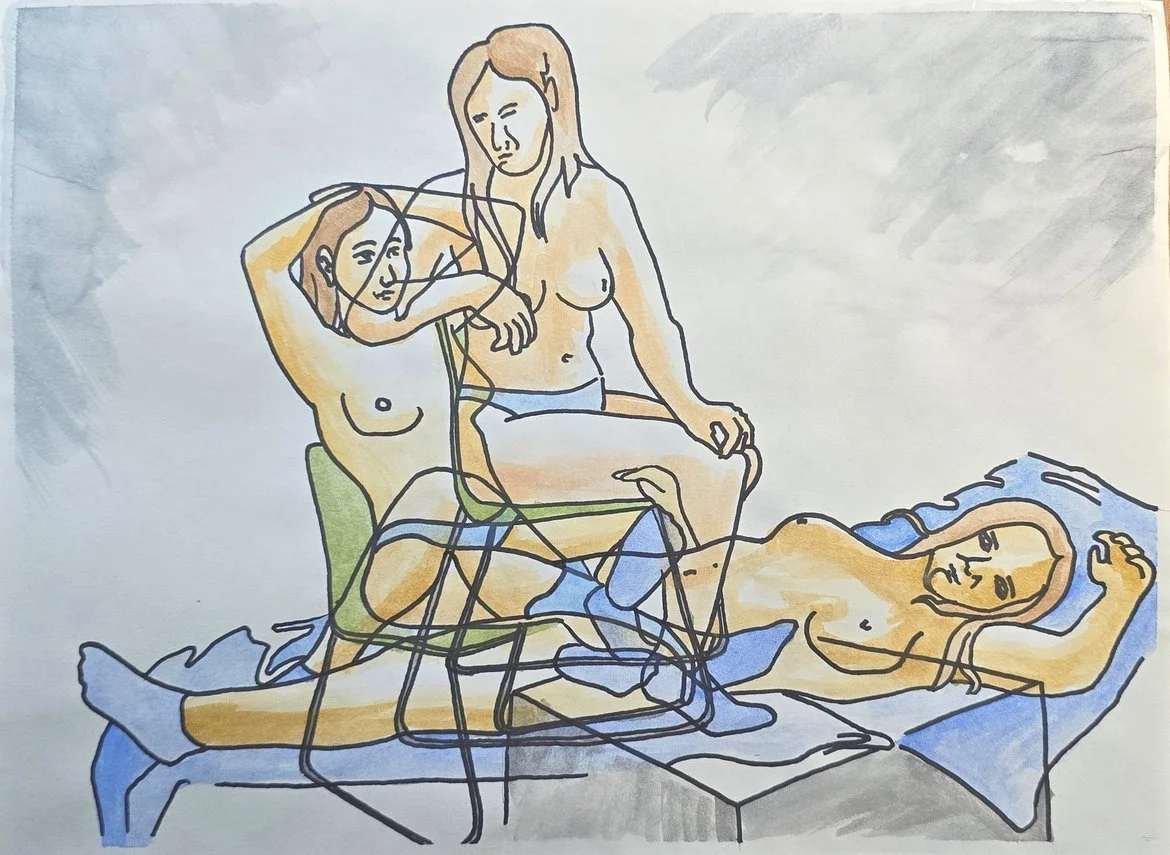
When I got home, I read about the ANONYME ZEICHNER 2027 (anonymous drawings 2027) juried show in Berlin and thought my “Blue Socks” piece would be perfect for it… but it’s larger than the permitted size. So I projected it onto a piece of sketch paper, got out my sharpie, and went to work… Here’s “Blue Socks #2”, sharpie and watercolor wash on sketch book paper, which at a bit under 9×12” is small enough to enter. It’s three poses layered on top of one another. We’ll see if the folks in Berlin like it… (below)
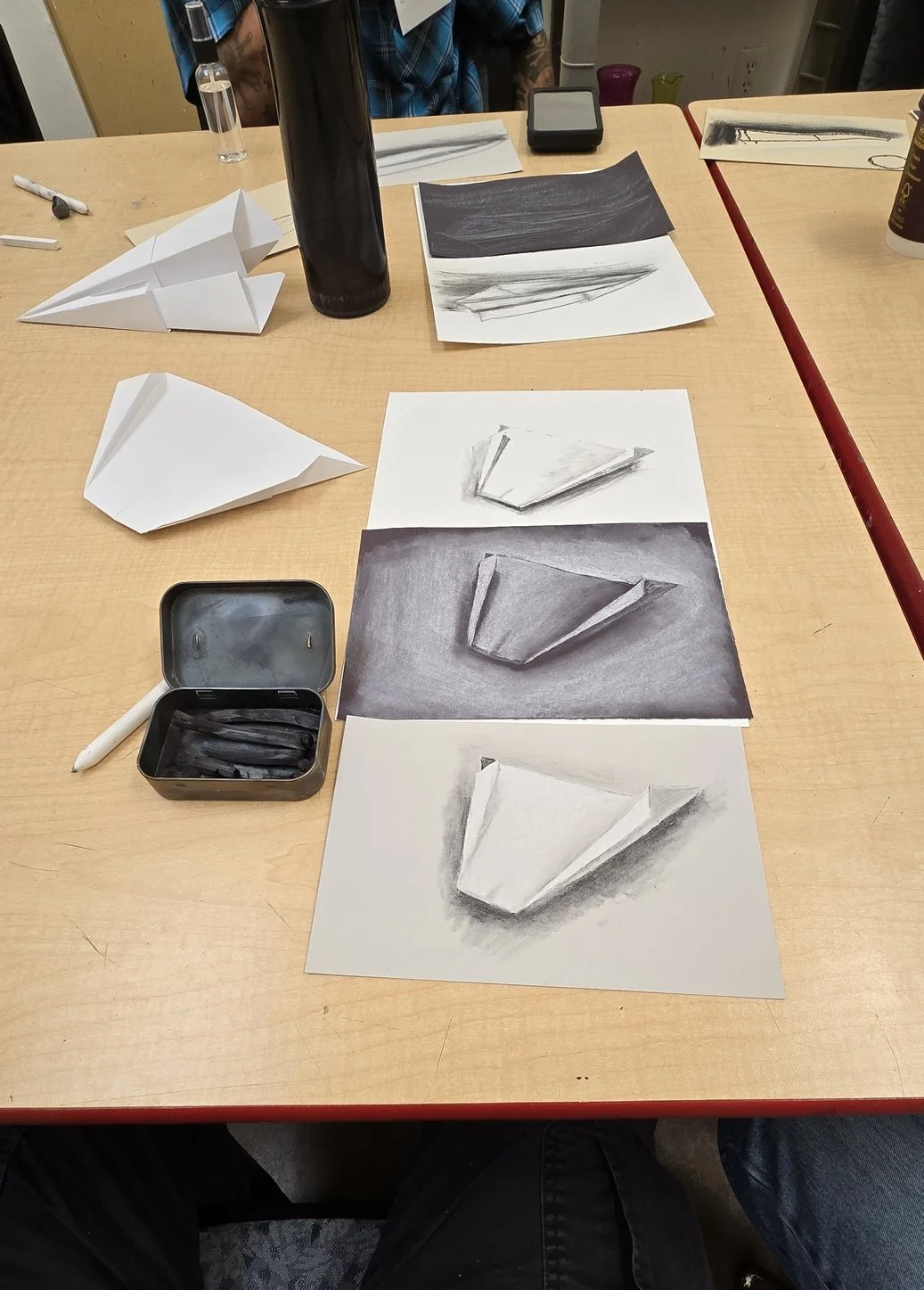
10/6/2026: It’s been an incredibly busy time in our household, and I’ve got a fair bit of blog catching up to do. There were a couple of road trips (to deliver art to the Glacier Museum of Art and to a rehearsal for the Butte Symphony) and a whole lot of other things going on. I only remembered to take just a handful of pics of what I’ve been doing for this blog. First up: a pic of the charcoal sticks we made out of willow branches baked in a wood fire in an ‘altoids’ tin (a couple of small holes in the lid let air and smoke escape while it heats up). Then, three drawings using (commercial) white and (our home-made) black charcoal on white, black, and grey paper… the goal is to achieve the same values of light and dark on each paper - I was only partially successful. The drawings are of a paper airplane, also in the pic…
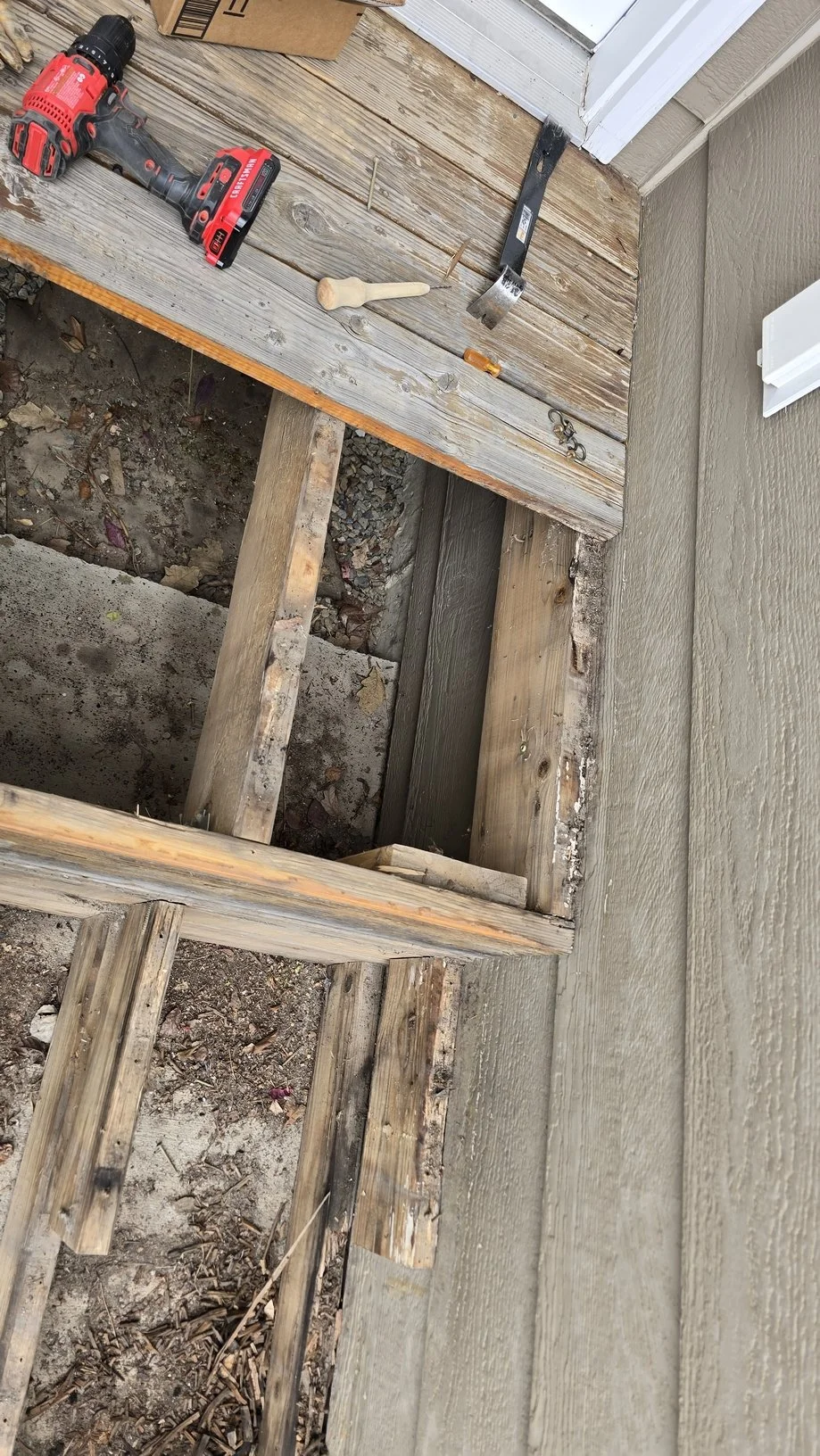
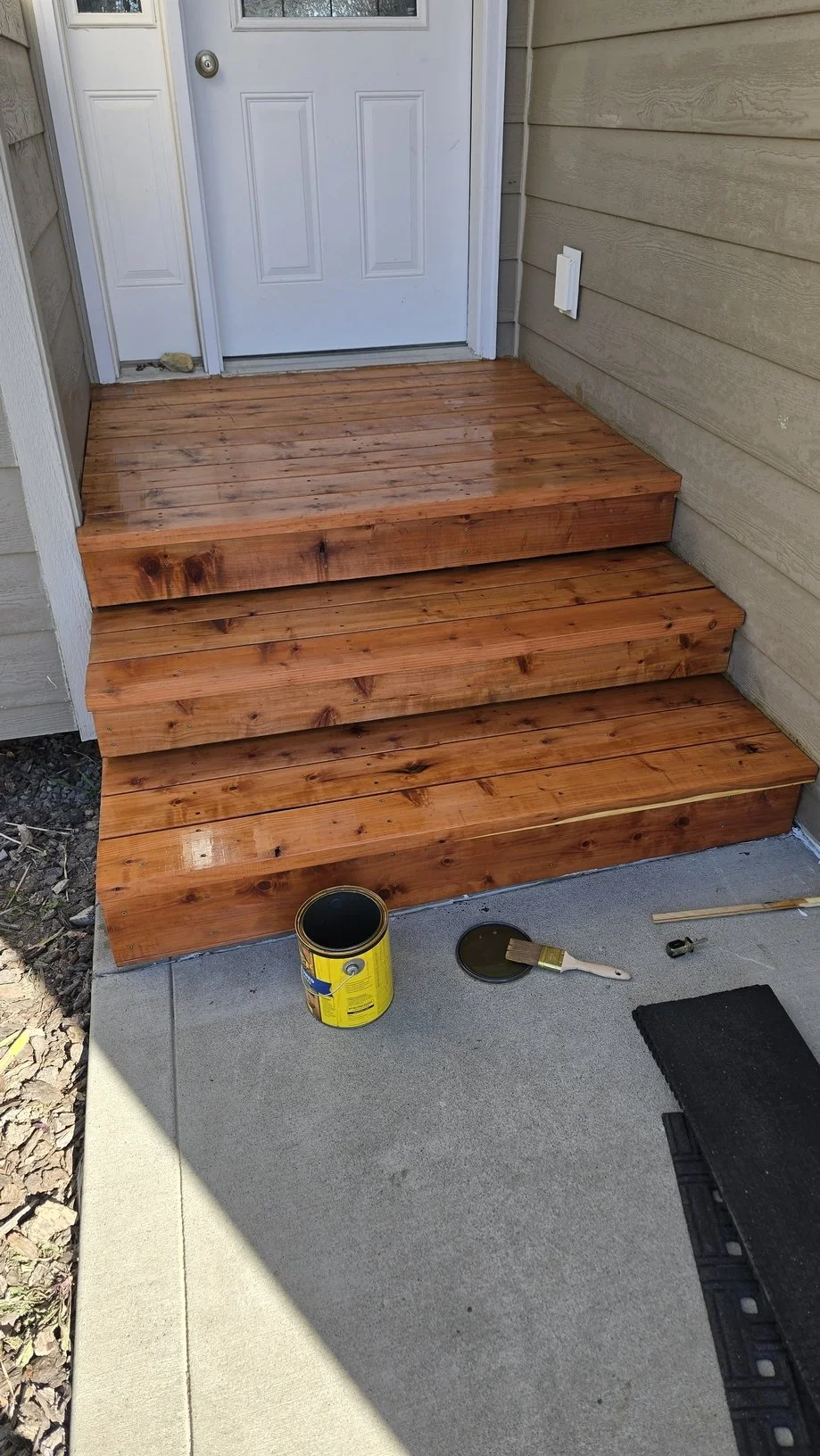
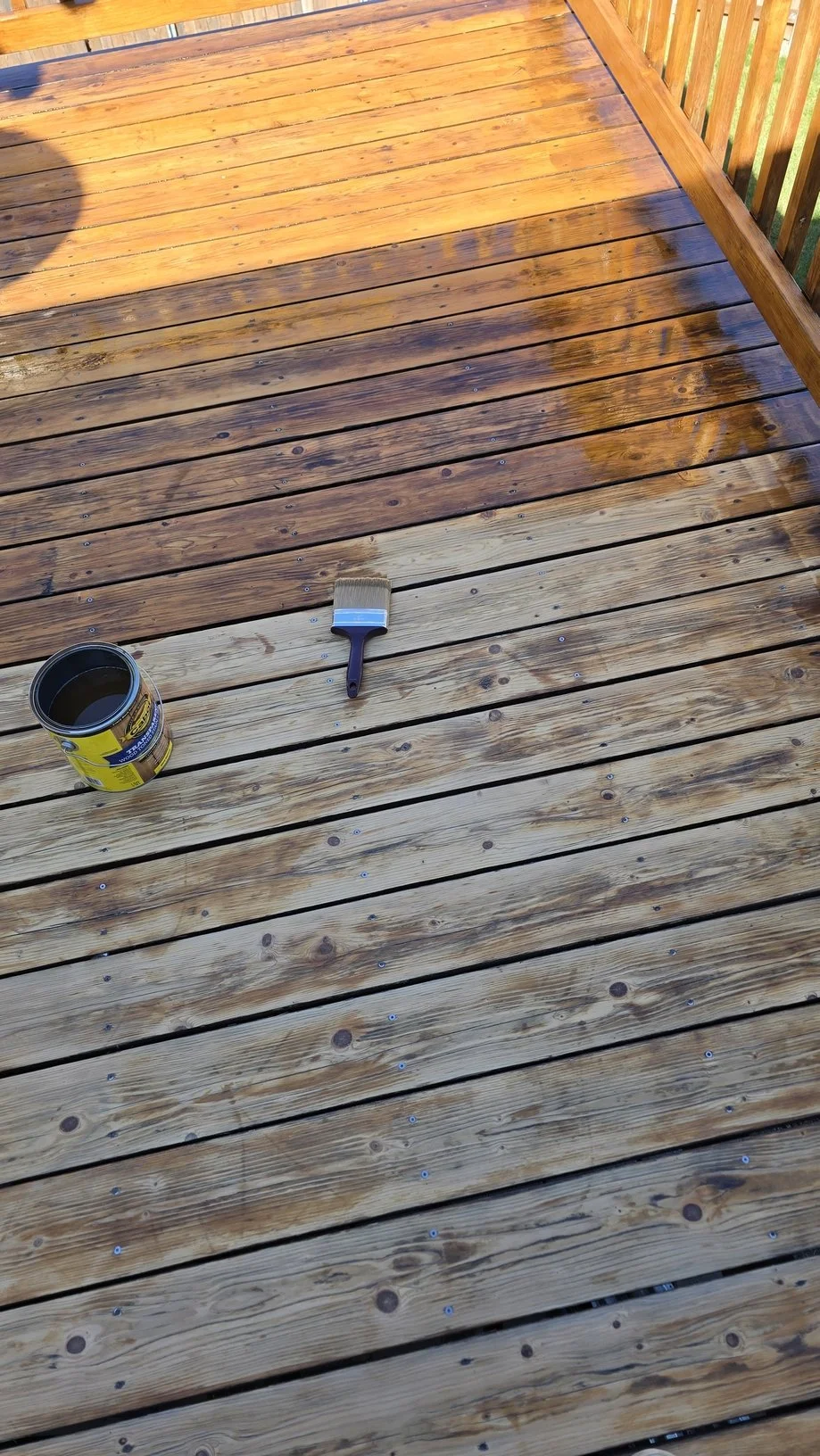
I’ve also been spending a lot of ‘quality time’ working with wood and with a paintbrush… um, but not creating art per se. Winter is fast approaching here in Montana, and there are some tasks that can’t be put off any longer. Our front steps needed replacing - the first pic below shows why. Lots of rot… and once I built new steps, it was time for a four-inch brush and a can of stain (second pic below). Then there was helping my honey in preparing the garden for winter; digging in our extremely rocky soil (pickaxe and crowbar required!) to plant new tulip bulbs in anticipation of next spring; attending to our watering systems (flower and vegetable gardens, lawn sprinklers); taking down our rain barrels'; and all those other miscellaneous chores that come with our modest house and Montana’s climate. And.. when all that was done, I got to work with a brush again!… um, yep, to get a couple of coats of stain on our deck. No artist gets to spend all their time creating art. Rehearsals and a concert this weekend, and then I should be set to create more art. Stay tuned!
Speaking of staying tuned, if you should happen to be in Butte this weekend, the Butte Symphony concert on the 10th should be a good one - a Mozart concerto for flute and orchestra, two pieces by French romantic composer Massenet, a nice Bach piece… worth it for sure!
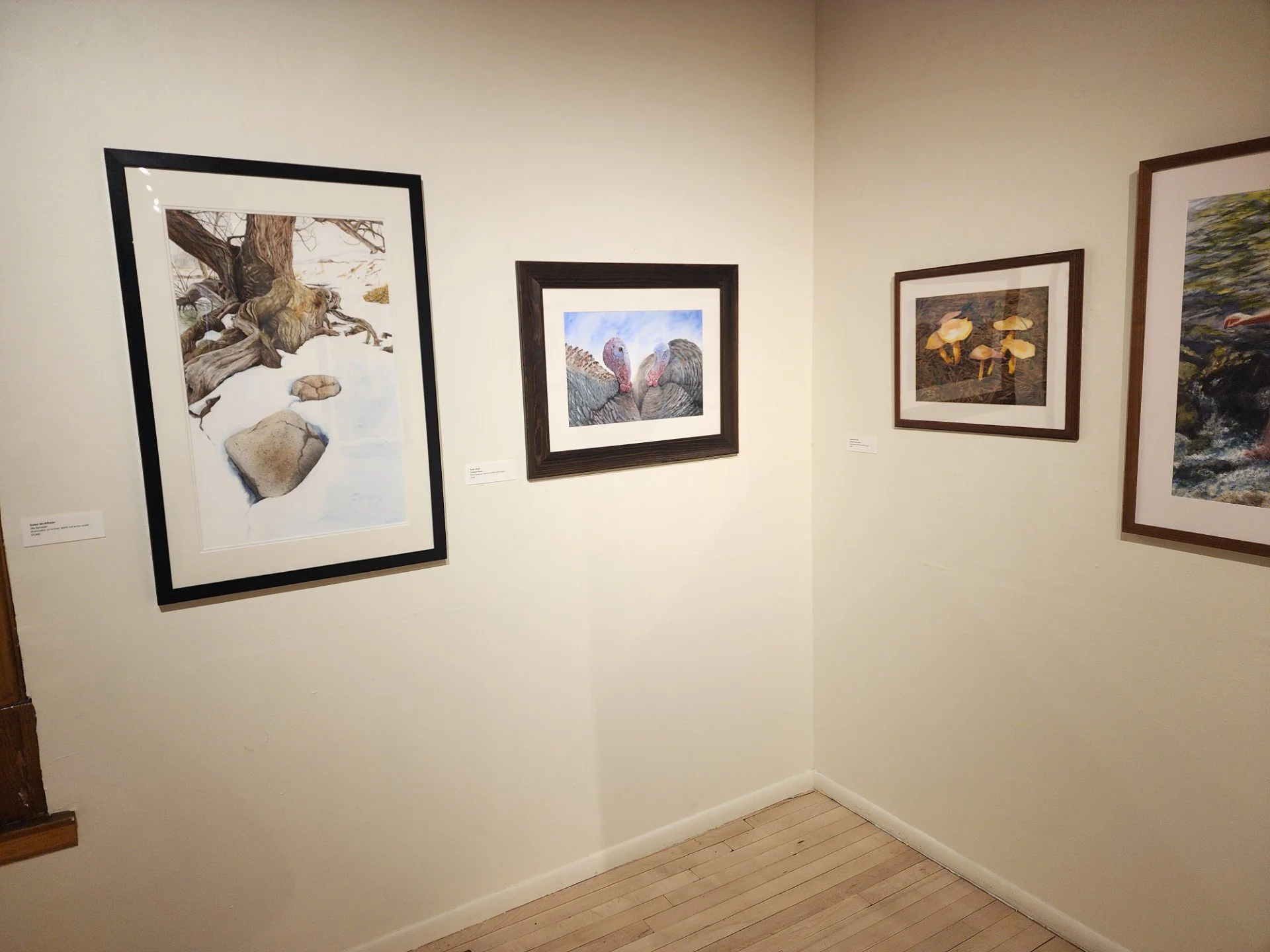
10/11/2026: (above) The painting on the left is my watercolor “The Survivor” as hanging in the Glacier Art Museum / Montana Watercolor Society [MTWCS] exhibit “Watermedia 2026” (to see the image, check out my “landscapes - Tenmile Creek Park" page on this website). I unfortunately could not make it back to Kalispell for the exhibit, but I know from the MTWCS website that there’s a lot of really great work on display. If you’re in the area and want to see just how incredible water-based media can be, you should stop in! Many thanks to Janet Bristol of the MTWCS for the photo!